How Long Do Backlinks Take to Work? The Short Answer
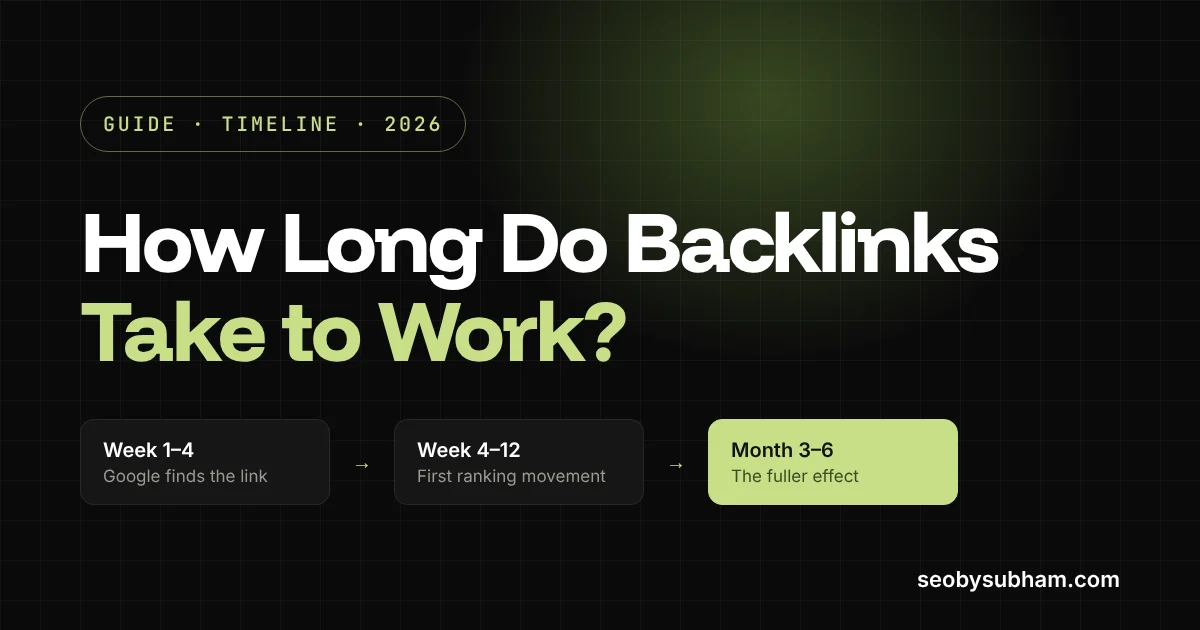
Most backlinks take 4 to 12 weeks to show their first effect on rankings, usually on long-tail keywords first. The full effect on your main keyword tends to come after 3 to 6 months. On a new domain, expect the slower end: in the client case below, the first rankings appeared about 6 to 8 weeks after link building started, and page one rankings about 10 to 11 weeks in.
A strong link to an established site can show up sooner. A brand-new domain, or a keyword with tough competition, usually takes longer.
That range is wide because “working” happens in stages. Google has to find the page your link sits on, index it, decide how much the link is worth, and then compare your page with everything else that ranks. This guide walks through each stage, what you can check along the way, and a client campaign on a new domain from August to October 2026, with the Semrush charts.
I'm Subham Chowdhury. I've worked in SEO since 2014 and built links for clients since 2018, and this is the timeline I give clients before any campaign starts.
What “Working” Means: 4 Different Clocks
People ask the same question but mean different things. It helps to separate them, because each one runs on its own schedule.
- The link is live. The page with your link is published. This is day one.
- Google has found it. Google crawls the linking page and indexes it. A link on a page Google never indexes can't pass anything to you.
- Your backlink tool shows it. Ahrefs and Semrush use their own crawlers, not Google's. A link can show up in a tool before Google has counted it, or weeks after.
- Rankings and traffic move. This is what most people mean by “working”, and it's the slowest of the four.
So if a link shows up in Ahrefs after five days, that tells you Ahrefs found it. It doesn't mean Google has counted it yet. And if it doesn't show up in Ahrefs after a month, that doesn't mean Google missed it.
The Backlink Timeline, Week by Week
This is the pattern I see across my client campaigns since 2018. Your own timing will move up or down with the factors in the next sections.
| When | What's usually happening | What you can check |
|---|---|---|
| Day 0 | The link goes live | The link is in the article, dofollow, and the page has no noindex tag |
| Week 1–4 | Google crawls and indexes the linking page | Search Google for site: plus the linking page's URL |
| Week 2–6 | Backlink tools pick up the link | Ahrefs, Semrush or Search Console's Links report |
| Week 4–12 | First ranking movement, mostly long-tail keywords and positions 20–100 | Your page's keyword count and positions in Semrush, Ahrefs or Search Console |
| Month 3–6 | Movement on the main keyword, first clicks from search | Rankings for the target keyword, organic traffic to the page |
| Month 6+ | The effect of several links adds up; competitive keywords move | Traffic trend over months, not weeks |
Two things stand out once you watch this across many sites.
Long-tail keywords move first. A page usually starts ranking for longer, less competitive phrases before it moves on its main keyword. If your keyword count is growing in positions 20–100, the links are doing something, even if the main keyword hasn't moved yet.
Rankings wobble before they settle. It's common to see a page jump, drop back, then climb again over a few weeks. One week of data tells you very little. Look at the trend over a month or more.
How Long for Backlinks to Take Effect: By Site and Link Type
Where you start makes the biggest difference. These ranges come from my own client campaigns since 2018. They are typical, not promises.
| Your situation | First signs | Fuller effect |
|---|---|---|
| Established site, link in an older article that's already indexed, low-competition keyword | 2–6 weeks | 2–3 months |
| Established site, new guest post on a relevant site, medium competition | 4–8 weeks | 3–4 months |
| New domain (under a year old), foundation links and Web 2.0 blogs plus a few outreach links | 6–12 weeks | 4–6 months or more |
| Any site, competitive head keyword | 2–4 months | 6–12 months or more |
| Links from spammy or unrelated sites | Often never | — |
Why the link type matters:
- Links in older, indexed articles are on pages Google already crawls. Google only has to notice the change, not discover a new page. That's why niche edits placed in aged, indexed articles often show up sooner than a new post. Mine go live in 10–12 days, on articles I've already checked are indexed.
- New guest posts need the new article to be crawled and indexed first. On a well-run site that takes days. On a site that publishes rarely, it can take a few weeks. A good guest post on a relevant site with its own traffic is still one of the strongest links you can get. It just starts a little later.
- Foundation links and Web 2.0 blogs are individually weak. They help a new site get crawled, give Google more paths to your pages and fill out a natural profile. They rarely move a competitive keyword on their own, so their effect is slower and quieter.
That's also why my monthly link building services use both: foundation links and Web 2.0 blogs to get a site crawled and give it a natural profile, and outreach links to move rankings.
A Real Example: A New Domain From August to October 2026
A New Domain in Numbers
- 0ranking keywords in August
- 9ranking keywords in September
- 33ranking keywords in October
- 6on page one, 1 in the top 3
This is a client site, a brand-new domain with no rankings and no backlinks before August 2026. I've hidden the domain to protect the client.
What we built: from the first week of August, a mix of Web 2.0 blogs, social profiles, forum profiles and posts, and other foundation links, plus 2–3 outreach links. The aim for the first months was to get a new site crawled and give it a normal, varied link profile before heavier outreach.
What happened, according to Semrush:
| Month | Ranking keywords | What changed |
|---|---|---|
| August 2026 | 0 | Links start going live |
| September 2026 | 9 | First rankings: 1 in positions 11–20, 4 in 21–50, 4 in 51–100 |
| October 2026 | 33 | 6 on page one (1 in the top 3, 5 in positions 4–10), 10 in 11–20, 10 in 21–50, 5 in 51–100, plus 2 SERP features; 25 estimated visits a month, all non-branded |
What this case shows:
- Nothing happened in the first month. That's normal. Google had to find the new links and the new site first.
- The first rankings came after about 6 to 8 weeks, all of them outside page one. This is the “long-tail first” pattern from the timeline above.
- Page one rankings appeared after about 10 to 11 weeks: 6 keywords, one of them in the top 3, along with the first estimated traffic.
- The main work is still ahead. 25 visits a month is a start, not a result. On a new domain, the 3–6 month window is where the bigger moves usually come.
Two honest caveats. The traffic figure is a Semrush estimate, not Search Console data, so treat it as a direction rather than an exact count. And the site was new, so pages were being published and Google was learning the site at the same time. Links played a big part, but I wouldn't credit every ranking to them alone.
On established sites the same pattern runs faster. On my homepage you can see a tech client's traffic sit flat at about 200 visits a month (Semrush estimate), then climb to about 650 once the links started to count. My guest posting service page shows a movie website where clicks started rising about four weeks after two guest posts went live, from 15.2K to 43K in a later three-month view in Search Console.
The weekly link count in Figure 1 isn't a target either. Most of those links are quick foundation links, which come in faster than outreach links and count for less each. The number that matters more for your own site is how many backlinks your keyword needs. More campaigns, with dates and sources, are on my link building case studies page.
What the Research Says (and Its Limits)
You'll see “backlinks take 10 weeks to work” quoted on many sites. It comes from an older Moz experiment by Kristina Kledzik. She tracked 76 links pointing to pages on her employer's blog, for keywords of low to medium difficulty, and found that on average it took about 10 weeks for a page to move up one position.
It's a useful data point, and it lines up with what most link builders see. But it was one established site, a small sample and one type of keyword. It's not a rule for every site, and it says nothing about new domains or competitive terms.
Google doesn't publish a timeline either. Its own guide to how Search works explains that crawling and indexing aren't guaranteed, which is the first reason some links take much longer than others, or never count at all.
What Makes Backlinks Work Faster, and What Slows Them Down
What speeds things up
- Links on pages Google visits often. A link in an article on an active, well-linked site gets crawled sooner than one buried on a page nobody links to.
- Relevance. A link from a site about your topic, in a paragraph about your topic, carries more weight than a link from an unrelated site. More weight means you need fewer links before anything moves.
- A strong target page. Links help a page that already deserves to rank. If the content doesn't match what searchers want, links take longer and do less.
- Internal links. Linking to your target page from your stronger pages helps Google find it and passes some of your site's own strength to it. It costs nothing, so do it first.
- An established site. A site Google already trusts tends to react to new links faster than a new one.
What slows things down, or stops links working
- Links on pages that aren't indexed. If Google hasn't indexed the linking page, the link can't help you.
- Spammy links. Google's spam policies treat buying or exchanging links to manipulate rankings as link spam, and Google has said its SpamBrain system can neutralize unnatural links, so they pass nothing. Hundreds of cheap links can take a long time to “work” because they never will.
- The same exact-match anchor text again and again. It looks built, not natural. Mix in your brand name, your URL and natural phrases.
- Hard competition. If the pages on page one have dozens of strong links each, a handful of new links will move you, but not past them.
- Stopping too early. Many campaigns end around month two, just before the stage where links usually start to show.
Backlinks vs SEO as a Whole: Why the Timelines Differ
“How long does SEO take” is a bigger question than how long backlinks take. Rankings depend on three things working together: the technical health of your site, the content on the page, and the links pointing to it. Each runs on its own clock.
| Part of SEO | Usual time to show | Why |
|---|---|---|
| Technical fixes | Days to a few weeks | They count once Google recrawls the affected pages |
| New or improved content | A few weeks to a few months | The page has to be indexed, then settle in the rankings |
| Backlinks | 4–12 weeks for first signs, 3–6 months for more | Google has to find the linking page, then reassess yours |
Links can't make up for a page Google can't index or a page that doesn't match what searchers want. That's why most SEO work is judged at six months, not six weeks, and why I check a client's site before any links are built.
How Long Do Backlinks Take to Show Up and Get Indexed?
In backlink tools
Ahrefs, Semrush and Moz each crawl the web on their own schedule. A link on a busy site may show up within days. A link on a small or new page can take a few weeks, and some never show up at all, because no tool crawls every page. If a link is missing from one tool, check another, and open the page yourself to confirm the link is there.
In Google Search Console, the Links report shows the external links Google has found to your site. It updates slowly and doesn't list every link, so use it as a check, not a full list.
In Google
Indexing usually takes from a few days to a few weeks for the page your link is on. To check, search Google for site: followed by the exact URL of the linking page. If it shows up, the page is indexed.
You can't use Search Console's URL Inspection tool on a site you don't own, so you can't request indexing for someone else's page. You can request it for your own target page, which helps Google see changes on your side.
How to get backlinks indexed faster
- Choose sites that get their pages indexed. Before paying for any link, search
site:plus a few recent articles on that site. If recent posts are missing from Google, a new post with your link may be missing too. I run this check on every site before offering it. - Share the linking page. A post on your social profiles or a newsletter gives Google another path to it.
- Link to it from your own properties. A mention from your Web 2.0 blog or a profile is one more way for Google to reach the page.
- Be careful with “indexer” tools. Paid indexing services vary a lot, and many just build low-quality links to the page. If a page won't get indexed on its own after a month or two, that usually says something about the site, and a better placement is often the better fix.
How Long Do Backlinks Last?
A backlink keeps working for as long as the page stays live, stays indexed and keeps the link. Some links last for years. Many don't. Ahrefs' link rot study found that 66.5% of links to the 2 million+ websites it sampled since 2013 had been lost.
Links usually disappear for ordinary reasons: a site redesign, a deleted post, an expired domain, or a publisher cleaning out old paid links. A link can also lose value without being removed, if the linking site loses its traffic or drops out of Google's index.
Two things help:
- Check your important links every few months. Open the page, confirm the link is still there and the page is still indexed.
- Buy from someone who replaces removed links. For my own clients, a guest post link removed within 12 months is replaced on a site the client approves, or refunded, and niche edit links removed within 6 months are replaced or refunded.
When Should You Worry That Your Backlinks Aren't Working?
Patience is part of link building, but it shouldn't mean waiting forever without checking. Here's what I look at, and when.
| Point | What should be true | If it isn't |
|---|---|---|
| Week 4 | Every link is live, dofollow where expected, and the linking pages are indexed | Ask for the placement to be fixed or replaced |
| Week 8 | Your page ranks for more keywords than before, even in positions 20–100 | Check the target page's content and internal links, and the relevance of the linking sites |
| Week 12 | Some keywords have moved up clearly, and impressions are rising in Search Console | Compare your links with the pages that rank; you may need stronger or more relevant links |
| Month 6 | The main keyword has moved, and traffic to the page is growing | Rethink the target keyword, the page or the link sources rather than adding more of the same |
If nothing at all has moved after six months, more of the same links won't fix it. Something about the page, the keyword choice or the quality of the links needs to change.
Frequently Asked Questions
Short answers to the questions people ask most about backlink timelines.
Why do backlinks take longer on a new website?
Google has to find and assess the new site itself, not only the link. A new domain has few indexed pages, gets crawled less often and has no track record yet. In the client case above, the first rankings came 6 to 8 weeks after link building started, and page one rankings after 10 to 11 weeks.
How long does link building take to show results?
Expect the first signs after 1 to 3 months and clearer results after 3 to 6 months of consistent work. Link building works over months, so a campaign that stops after four to six weeks usually ends before the links have had time to show.
How long does it take for backlinks to show up in Ahrefs or Semrush?
Usually a few days to a few weeks. Each tool uses its own crawler, so the timing differs between tools, and some links never show up in any of them. Open the linking page yourself to confirm the link is live.
How do I get backlinks indexed fast?
Choose sites whose new posts get indexed, then share the linking page and link to it from your own profiles so Google has more ways to find it. You can't request indexing for a page on someone else's site, so the quality of the site matters most.
Can a backlink work in a few days?
Sometimes. A link from a large, frequently crawled site to an established page, for a low-competition keyword, can move rankings within days. That's the exception. Plan around weeks and months.
How many backlinks do I need to see results?
It depends on your keyword. Count the referring domains of the pages already on page one and match their quality. My guide on how many backlinks you need walks through the method with live examples.
Do nofollow backlinks take effect?
Google treats nofollow as a hint, so it may or may not use a nofollow link for ranking. These links can still help Google discover your page and send visitors. Don't expect one to move rankings the way a dofollow link from a relevant site can.
How long until backlinks raise my DR or DA?
DR (Ahrefs) and DA (Moz) are third-party scores, not Google's. They change when that tool finds your new links and recalculates, which can be days to weeks after a link goes live. A higher DR doesn't mean Google has counted the links yet, and rankings can move before DR does.
How long do backlinks last?
As long as the page stays live, stays indexed and keeps the link. Many links are lost over time through redesigns, deleted posts and expired domains, so check your important links every few months.
The Bottom Line
So, how long do backlinks take to work? Plan on 4 to 12 weeks for the first signs and 3 to 6 months for the fuller effect, with new domains and tough keywords at the slower end. Check the right things at each stage: the link is live, the page is indexed, your keyword count is growing, then rankings and traffic.
If you're new to this, start with what link building is and how to get backlinks. If you're comparing providers, ask each one what timeline they expect for your site, and why. My guide on how to choose a link building service has the questions worth asking.

Send Me Your Page
Tell me your page and keyword. I'll check what's live, what's indexed and what the pages ranking above you have, and tell you what to expect before you pay anything.