- High authority backlinks come from sites with real traffic, a clear topic and a clean link profile, placed on a relevant page Google can index.
- DA and DR are third-party scores, not Google metrics. Use them to shortlist sites, then check traffic, relevance and outbound links.
- A high DA with no traffic is a red flag. Scores can be inflated with links; readers and rankings can't.
- Editorial links carry the most weight: guest posts, digital PR and outreach. Profiles, Web 2.0 blogs, bookmarks and PDF shares build the base around them.
- Mix dofollow and nofollow links. A natural profile has both, built steadily over time.
1. What Are High Authority Backlinks?
High authority backlinks are links to your website from sites that search engines already trust. A trusted site usually has three things: a strong backlink profile of its own, real visitors who find it through search, and a clear topic. In SEO tools, that trust shows up as a high Domain Authority (DA) or Domain Rating (DR), which is why you'll also hear them called high DA backlinks, high domain authority backlinks, authoritative backlinks or simply authority backlinks.
The idea goes back to how Google was built. A link works a bit like a vote: when one page links to another, it's telling readers “this is worth a look.” Votes from pages that are themselves well linked and well read count for more than votes from pages nobody visits. A single link from a respected site in your niche can do more for a page than a hundred links from sites no one has heard of.
But “high authority” has turned into a sales label. Plenty of sites carry a big DA number and have no readers, no rankings and links to anything that pays. So in this guide, high authority means two things together:
- The site is trusted. Real traffic, real rankings, and a backlink profile that wasn't bought in bulk.
- The link makes sense. It sits on a page related to your topic, inside content a reader would actually see, on a page Google can index.
If you're new to the subject, my guide to what link building is covers the basics. This page is about the top end: the links that carry the most weight, and how to tell the real ones from the copies.
A high authority backlink is a link from a site that is trusted for real reasons, on a page that's relevant to yours. DA tells you where to start looking. Traffic, relevance and link placement tell you whether the link is worth having.
2. DA, DR and What Google Actually Uses
Domain Authority and Domain Rating are third-party scores, not Google metrics. Google doesn't look up a site's DA before deciding how much a link is worth. These scores are estimates made by SEO tool companies to help you compare sites quickly, and they're useful for exactly that.
Here's what each of the common scores measures:
| Score | Made by | Scale | What it estimates |
|---|---|---|---|
| Domain Authority (DA) | Moz | 1–100 | How likely a domain is to rank, compared with other domains, based mostly on its links |
| Domain Rating (DR) | Ahrefs | 0–100 | The strength of a domain's backlink profile |
| Authority Score (AS) | Semrush | 0–100 | Overall domain quality from links, organic traffic and spam signals |
| Trust Flow (TF) / Citation Flow (CF) | Majestic | 0–100 | TF: how close a site is to trusted seed sites. CF: how many links point to it |
All of these scales are logarithmic, so moving from DA 70 to DA 80 is much harder than moving from DA 20 to DA 30. They also won't agree with each other. A site can be DA 60 on Moz and DR 45 on Ahrefs, because each tool crawls a different set of links and weighs them its own way. Moz states that DA is not a metric Google uses to rank pages, and Ahrefs points out that Google ranks pages, not whole websites.
What Google does care about is written in its own guidance. Its link spam policy is clear that links made mainly to manipulate rankings, including links bought to pass ranking credit, break its rules. And it asks sites to mark paid and user-generated links with rel=“sponsored” or rel=“ugc”. In other words, Google rewards links that were given for a reason, from sites people trust. A score is just a quick way to guess which sites those might be.
So what DA counts as “high”? As a rough guide, DA 50 and above is considered high, and DA 70 and above is very high. Similar bands are used for Ahrefs scores, which is why sellers advertise “high DR backlinks” alongside high DA links. Context matters more than the cut-off, though. In a small niche, a DA 35 site that every expert in the field reads is a far better link than a DA 80 general news site that will publish anything for a fee.
3. How to Check If a Site Has Real Authority
This is the step most guides skip, and it's the one that saves you the most money. I've been building links since 2014, and the checks below are the ones I run on every site before I place a client's link there. You can run them yourself in about five minutes per site, using free tools or the free tiers of Semrush, Ahrefs and Majestic.
| Check | How to check it | Good sign | Red flag |
|---|---|---|---|
| Organic traffic | Traffic estimate in Semrush or Ahrefs, last 12 months | Steady or growing traffic from your target countries | High DA but almost no traffic, or a sudden crash |
| Topical relevance | Read the homepage and the last 10 posts | A clear subject close to yours | Crypto, recipes, roofing and casinos on one blog |
| Outbound links | Open a few recent posts and look at who they link to | Links to useful sources, a few per article | Every post links to a different paying site |
| Trust Flow vs Citation Flow | Majestic site lookup | TF reasonably close to CF | CF high, TF very low: lots of links, few trusted ones |
| Indexed and ranking | Search site:domain.com on Google; check ranking keywords | Pages indexed, ranking for real search terms | Few indexed pages or no keywords at all |
| Link placement | Inspect where your link would sit, and its rel attribute | Inside the article, on an indexable page | Footer, sidebar, or a page marked noindex |
A site doesn't need a perfect score on all six. A respected niche blog with modest traffic can still be a great link. But if a site fails two or more of these checks, its DA is telling you a story that isn't true, and you should walk away no matter how high the number is.
The 10-Second Gut Check
Ask yourself one question: would I want this link even if it passed no SEO value at all? If the site could send you real readers, or you'd be proud to tell a client you were mentioned there, it's probably a genuine high authority backlink. If the only reason to want it is the number next to its name, it probably isn't.
4. Red Flags: How to Spot Fake Authority
DA and DR are calculated from links, so anyone who builds enough links can push a site's score up, whether or not the site deserves it. When I ran a backlink gap report for my own site against four competitors, most of the “high DA” domains linking to them turned out to be auto-generated pages: “website worth” calculators, screenshot directories and domain-info sites that create a page for every domain on the internet. They have big numbers and add nothing. These are the warning signs I look for:
- A high DA with no traffic. DA 60 and a few dozen visits a month usually means the score was built with links, not earned with readers.
- A “write for us” page that accepts any topic. If they'll publish crypto today and dental care tomorrow, Google can see that too.
- Casino, CBD, loan and adult links between normal posts. A site that sells links to anyone is the kind of site Google tends to discount.
- Signs of a private blog network (PBN). An expired domain with a different history on the Wayback Machine, thin posts, no author names and links only to unrelated “money” sites.
- A score that jumped overnight. DA 10 to DA 50 in two months, with no growth in traffic, is almost always link manipulation.
- A seller who only talks numbers. “DA 90+ guaranteed” with no site names, no samples and no mention of traffic or relevance is a sales pitch, not a link plan.
5. How to Get Backlinks From High Authority Sites
If you're wondering how to get high authority backlinks without putting your site at risk, there's no shortcut that works for long, but there are seven methods that do. The first six earn editorial links, where someone else decides your page is worth linking to. The last one builds the supporting links around them. Most successful link profiles use a mix of all seven.
Guest Posts on Niche Sites
Write a genuinely useful article for a respected site in your industry, with a link back to a relevant page. Pick sites by the checks above, not by DA alone. This is the most reliable route for most businesses, and it's how my guest posting services work.
Journalist Requests and Digital PR
Reporters ask for expert quotes every day on platforms like Qwoted, Featured.com and SourceBottle. Answer quickly, with a real insight and your credentials, and the published article often links back to you. These are some of the strongest links you can get.
Create Something Worth Citing
Original data, a small survey, a free tool or a genuinely complete guide gives other writers a reason to link without being asked. Promote it once it's live: links rarely arrive on their own.
Broken Link Building
Find a dead link on a high authority page in your niche, then email the site owner with a working page of yours that covers the same topic. You're fixing their problem, which makes a yes far more likely.
Unlinked Brand Mentions
Search for your brand or name in quotes and look for articles that mention you without a link. A short, friendly email asking them to add one has one of the best reply rates in link building.
Resource Page Outreach
Many universities, associations and industry sites keep lists of useful resources. If your page genuinely belongs on one, ask to be added. Search "your topic" + "useful resources" to find them.
High DA Platforms
Profiles, Web 2.0 blogs, bookmarks and document shares on trusted platforms. You place these yourself, so they carry less weight, but they build a natural, varied base. The list below covers them.
If your time is short, start with methods 01, 02 and 05. They give the best return for the effort, and a handful of links from them will usually outweigh hundreds of links from method 07 on its own.
6. Types of High Authority Backlinks
Not all authority links do the same job. The simplest way to plan them is in layers: a broad base of platform links, a middle layer of content on your topic, and a small top layer of editorial links that carry most of the weight.
A Healthy Authority Link Profile, in Three Layers
The base is the widest, but the top layer does the most for your rankings.
Editorial Links
Guest posts, digital PR and outreach links on real, relevant websites. Fewest in number, highest in value.
Topical Content Links
Web 2.0 blogs and shared documents written about your subject, with a contextual link.
Platform Links
Profiles, social bookmarks and listings on high DA platforms that establish your brand across the web.
| Link type | Who places it | Usual attribute | SEO weight | Effort |
|---|---|---|---|---|
| Guest post | An editor on a niche site | Dofollow | High | High |
| Digital PR / journalist quote | A journalist | Mixed | High | High |
| Broken link / resource page | The site owner | Dofollow | Medium to high | Medium |
| Web 2.0 blog | You, on a free platform | Mostly dofollow | Low to medium | Medium |
| PDF / document share | You | Varies | Low | Low |
| Profile / bookmark | You | Mostly nofollow | Low | Low |
Nofollow doesn't mean useless. Google treats nofollow as a hint rather than a strict rule, and a profile made only of dofollow links looks engineered. Real brands collect a natural mix: nofollow mentions from profiles, forums and social sites alongside dofollow editorial links.
7. High Authority Backlinks List: High DA Sites by Category
Below is a high authority backlinks list of well-known platforms where you can create your own profile, blog, bookmark or document with a link to your site. I've grouped them into four categories and checked each one's Moz DA and link type in October 2026.
Two things to keep in mind as you read it. First, the DA belongs to the platform, not to your page: a new profile on a DA 92 site starts with no authority of its own. Second, these are layer 1 and layer 2 links. They're useful for building a natural base, but they won't replace the editorial links from section 5.
Profile Sites
| # | Site | DA | Link type | Effort |
|---|---|---|---|---|
| 1 | Gravatargravatar.com | 96 | Nofollow | Low |
| 2 | Pixabaypixabay.com | 94 | Nofollow | Low |
| 3 | TEDted.com | 93 | Nofollow | Low |
| 4 | Goodreadsgoodreads.com | 93 | Nofollow | Low |
| 5 | Disqusdisqus.com | 93 | Nofollow | Low |
| 6 | About.meabout.me | 92 | Nofollow | Low |
| 7 | Mixcloudmixcloud.com | 92 | Nofollow | Low |
| 8 | Product Huntproducthunt.com | 90 | Nofollow | Low |
| 9 | Sketchfabsketchfab.com | 90 | Nofollow | Low |
| 10 | Know Your Memeknowyourmeme.com | 90 | Nofollow | Low |
Profile links are the quickest to build. Fill in every field, add a real photo or logo and a proper bio, and link to your homepage or about page. An empty profile with just a URL is easy to spot and easy to ignore.
Web 2.0 Sites
| # | Site | DA | Link type | Effort |
|---|---|---|---|---|
| 1 | GitHubgithub.com | 97 | Dofollow | Medium |
| 2 | WordPress.comwordpress.com | 94 | Dofollow | Medium |
| 3 | Telegraphtelegra.ph | 93 | Dofollow | Medium |
| 4 | Bloggerblogger.com | 92 | Dofollow | Medium |
| 5 | Substacksubstack.com | 92 | Dofollow | Medium |
| 6 | Evernoteevernote.com | 92 | Dofollow | Medium |
| 7 | Diigodiigo.com | 91 | Dofollow | Medium |
| 8 | Strikinglystrikingly.com | 86 | Dofollow | Medium |
| 9 | Tumblrtumblr.com | 77 | Dofollow | Medium |
| 10 | Wixwix.com | 72 | Dofollow | Medium |
Web 2.0 platforms let you publish a full article with a link in context, which makes them the most useful platform links when they're done properly. Some platforms add a noindex tag to certain posts (Substack can), so check before you count a link. My Web 2.0 backlinks guide shows the full test and how to set these blogs up so they last.
Social Bookmarking Sites
| # | Site | DA | Link type | Effort |
|---|---|---|---|---|
| 1 | Scoop.itscoop.it | 92 | Nofollow | Low |
| 2 | Trellotrello.com | 92 | Nofollow | Low |
| 3 | Diigodiigo.com | 91 | Dofollow | Low |
| 4 | Instapaperinstapaper.com | 89 | Nofollow | Low |
| 5 | Padletpadlet.com | 89 | Nofollow | Low |
| 6 | Pearltreespearltrees.com | 86 | Nofollow | Low |
| 7 | List.lylist.ly | 85 | Nofollow | Low |
| 8 | Mindsminds.com | 83 | Dofollow | Low |
| 9 | Mixmix.com | 71 | Nofollow | Low |
Bookmarking works best for new pages: saving a fresh post to a few bookmarking and curation sites helps it get discovered. Add a short, original description to each bookmark rather than pasting the same text everywhere. Diigo appears in both this table and the Web 2.0 table because it works as both.
PDF and Document Sharing Sites
| # | Site | DA | Link type | Effort |
|---|---|---|---|---|
| 1 | SlideShareslideshare.net | 95 | Varies | Low |
| 2 | Dropboxdropbox.com | 95 | Varies | Low |
| 3 | Issuuissuu.com | 94 | Varies | Low |
| 4 | 4shared4shared.com | 94 | Varies | Low |
| 5 | Scribdscribd.com | 94 | Varies | Low |
| 6 | MediaFiremediafire.com | 94 | Varies | Low |
| 7 | Yumpuyumpu.com | 91 | Varies | Low |
| 8 | SlideServeslideserve.com | 71 | Varies | Low |
| 9 | AnyFlipanyflip.com | 70 | Varies | Low |
| 10 | MEGAmega.io | 59 | Varies | Low |
Turn a useful piece of content, like a checklist, a short guide or a case study, into a PDF with a clickable link inside, then share it on these sites. Link handling varies: some platforms keep links inside the document clickable, some add a link to the listing page, and storage sites like Dropbox, MEGA and 4shared mainly give you a shareable file. That's why the link type is marked “Varies”.
These are well-known platforms, shared so you can start right away. The list I use for client work is much bigger and includes niche platforms, forums and EDU sites that I re-check regularly. I keep that list private on purpose: once a platform appears on public “free backlinks” lists, it gets flooded with spam and soon switches its links to nofollow or deletes accounts in bulk.
Verify Before You Count a Link
Treat any list, including this one, as a starting point: a platform's settings can change after it's published. Open your live page and look at the code around your link. A nofollow, ugc or sponsored value in its rel attribute means Google sees it as a hint, not a vote. Then view the page source and look for a noindex tag; if one is there, Google won't show that page in search, so don't count the link.
8. How to Use These Sites Without Wasting Time
The goal is not to create an account on every platform in the list. The goal is a link profile that looks like a real brand's. Here's the order I'd work in:
- Pick 10 to 15 platforms that fit. Choose the ones your audience might actually use. A design studio belongs on Behance-style portfolio sites; a software company belongs on GitHub and Product Hunt.
- Use the same brand details everywhere. Same name, logo, short description and URL on every profile. Consistency helps search engines connect them to you.
- Make every profile and post complete. A full bio, a real image, and for Web 2.0 blogs and PDFs, original content of at least a few hundred words.
- Mix your anchors and targets. Use your brand name and URL most of the time, natural phrases sometimes, and your main keyword only rarely. Point some links at inner pages, not just the homepage.
- Spread the work out. A few links a week looks natural. Hundreds in a single day looks like software.
- Check, record and re-check. Keep a sheet of every live URL, its link type and whether it's indexed. Check it again after a month or two.
- Then focus on editorial links. Once the base is in place, put most of your time and budget into guest posts, PR and outreach. That's where rankings move.
9. High Authority Backlinks Service
Building links on high DA platforms properly takes hours: accounts, profiles, articles, documents, checking every link and recording it. If you'd rather spend that time on your business, my high authority backlinks service (some sellers call it a high DA backlinks service) does the work for you, by hand, using the platforms and checks described in this guide.
These packages build the base and middle layers of your profile: profiles, Web 2.0 blogs, social bookmarks, PDF shares, EDU and forum links and more, on high DA platforms, with a natural mix of dofollow and nofollow links. If you need editorial links on niche websites, see my guest posting services or the monthly link building packages, which combine both.
What's Included in Every Package
- Manual work only. Every profile, post and share is created by hand. No software, no spun content.
- High DA platforms. Web 2.0, social bookmarking, PDF, EDU, forum and profile sites, mixed for a natural profile.
- A natural link mix. Dofollow and nofollow links together, the way a real brand's profile looks.
- One URL, 3 to 5 keywords. Focused on a single page, with your anchors spread across brand, URL and keyword variations.
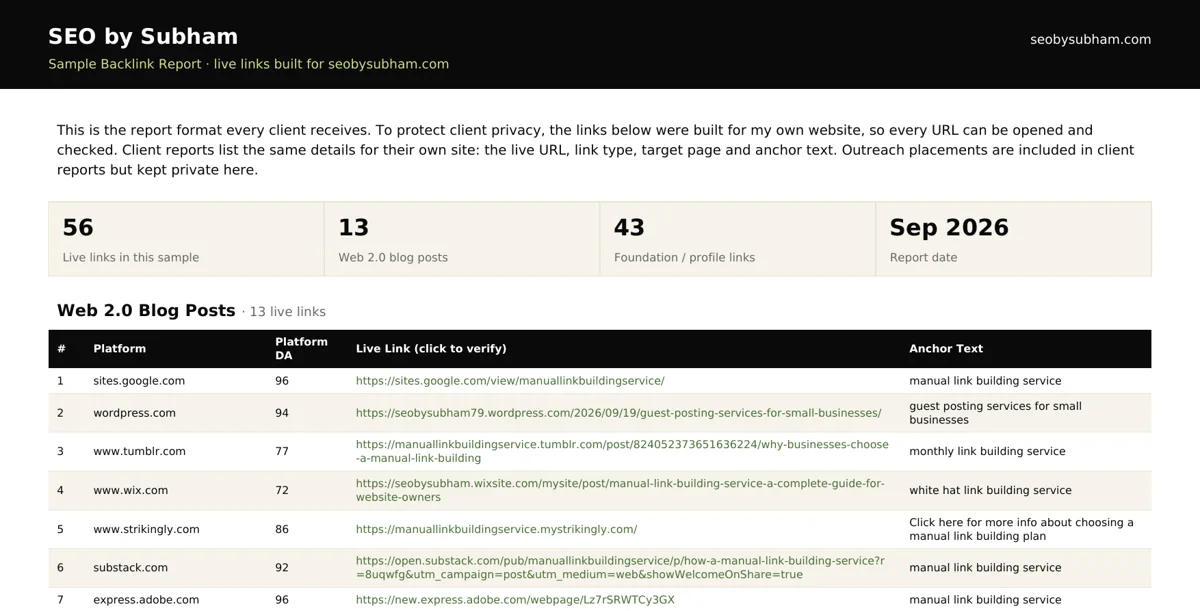
- A detailed Excel report. Every live link with its platform, so you can open and check each one yourself.
- 100% refund if you're not satisfied. Refunded within 3 to 4 days, no hassle. Read the refund policy.
High Authority Backlinks Packages
Three fixed-price packages. You get the delivery time before you order, and work starts once payment is confirmed.
Basic
For new websites
$60/one-time
- 100 High Authority Links
- Web 2.0, bookmarking, PDF, EDU, forum & more
- Dofollow & nofollow mix
- 1 URL · 3–5 keywords
- Detailed Excel report
- Delivery in 3–5 days
Best for new sites building their first base of links
Choose BasicStandard
Most PopularFor growing websites
$110/one-time
- 220 High Authority Links
- Web 2.0, bookmarking, PDF, EDU, forum & more
- Dofollow & nofollow mix
- 1 URL · 3–5 keywords
- Detailed Excel report
- Delivery in 4–6 days
Best for small businesses and blogs that need a stronger, more varied profile
Choose StandardPremium
For competitive niches
$200/one-time
- 450 High Authority Links
- Web 2.0, bookmarking, PDF, EDU, forum & more
- Dofollow & nofollow mix
- 1 URL · 3–5 keywords
- Detailed Excel report
- Delivery in 7–10 days
Best for established sites, online stores and agencies
Choose PremiumNeed several URLs, or a custom mix? Message me on WhatsApp or email subham@seobysubham.com. I don't accept casino, CBD or adult websites.
Who These Packages Are For
- New sites with very few backlinks that need a natural base.
- Sites with a few editorial links and nothing around them.
- Agencies that want platform links built by hand for their clients.
Who Should Look Elsewhere
- Pages in tough niches that need editorial links first. Platform links support them; they don't replace them.
- Sites with a Google manual action. Fix and clean up the profile before adding anything new.
- Casino, CBD and adult websites.
Want to see what you'll receive first? Open my sample backlink report. Your Excel report follows the same idea: every live link, ready to click and check.
10. Frequently Asked Questions
Short, direct answers to what clients ask me most about high authority backlinks:
High authority backlinks are links to your website from sites that search engines already trust: sites with a strong backlink profile, real organic traffic and a clear topic. SEO tools show that trust as a high Domain Authority (DA) or Domain Rating (DR), but a genuine high authority backlink also needs to be relevant to your site and placed on a page Google can index.
As a rough guide, DA 50 and above is considered high and DA 70 and above is very high. The number matters less than the context: a DA 35 site that everyone in your niche reads can be a better link than a DA 80 site that publishes anything for a fee. Always check traffic and relevance as well as the score.
No. Domain Authority is a score created by Moz, and Domain Rating is created by Ahrefs. Google doesn't use either one. They're useful estimates for comparing sites, but Google judges links by its own signals, such as how trusted and relevant the linking page is, and it ignores or penalizes links made only to manipulate rankings.
The methods that work best are guest posts on respected niche sites, answering journalist requests on platforms like Qwoted and Featured.com, creating original data or tools worth citing, broken link building, turning unlinked brand mentions into links, and resource page outreach. High DA platforms such as profiles, Web 2.0 blogs and document sharing sites add supporting links around them.
Yes. Profiles, Web 2.0 blogs, social bookmarks and PDF shares on high DA platforms cost nothing but time, and so do journalist requests, broken link building and brand mention outreach. The trade-off is effort: free links take hours of careful work to do properly, which is why many businesses pay someone to build them.
Yes, in a supporting role. Google treats nofollow as a hint rather than a strict rule, nofollow links can still send visitors and build brand visibility, and a natural link profile always contains a mix of dofollow and nofollow links. A profile with only dofollow links looks engineered.
It depends on what you're buying. Google's spam policies say that buying links which pass ranking credit, without marking them as sponsored, breaks its rules. Paying someone to do the manual work of building profiles, blogs and shares on public platforms, or to pitch real publishers, is a service rather than buying a link. Avoid anyone selling a guaranteed DA number from a hidden list of sites.
There's no fixed number. It depends on your competition: look at how many referring domains the pages ranking on page one have, and aim to build a similar, natural mix over time. A few editorial links from relevant sites, supported by a varied base of platform links, usually outperform hundreds of links of one type.
Usually anywhere from a few weeks to a few months. Google has to find and index the linking page first, then re-evaluate your page. Editorial links on well-crawled sites tend to show results faster than new profiles and Web 2.0 posts, which may take longer to get indexed.
Each package covers one URL and 3 to 5 keywords, and includes high authority links on Web 2.0, social bookmarking, PDF, EDU, forum and profile sites, with a natural mix of dofollow and nofollow links. Basic is 100 links for $60 (3 to 5 days), Standard is 220 links for $110 (4 to 6 days) and Premium is 450 links for $200 (7 to 10 days). Every order comes with a detailed Excel report of all live links.

Get High Authority Backlinks, Built by Hand
Profiles, Web 2.0 blogs, bookmarks, PDF, EDU and forum links on high DA platforms, with a natural link mix and an Excel report listing every live link. Packages from $60.