What Are Foundation Backlinks? The Short Answer
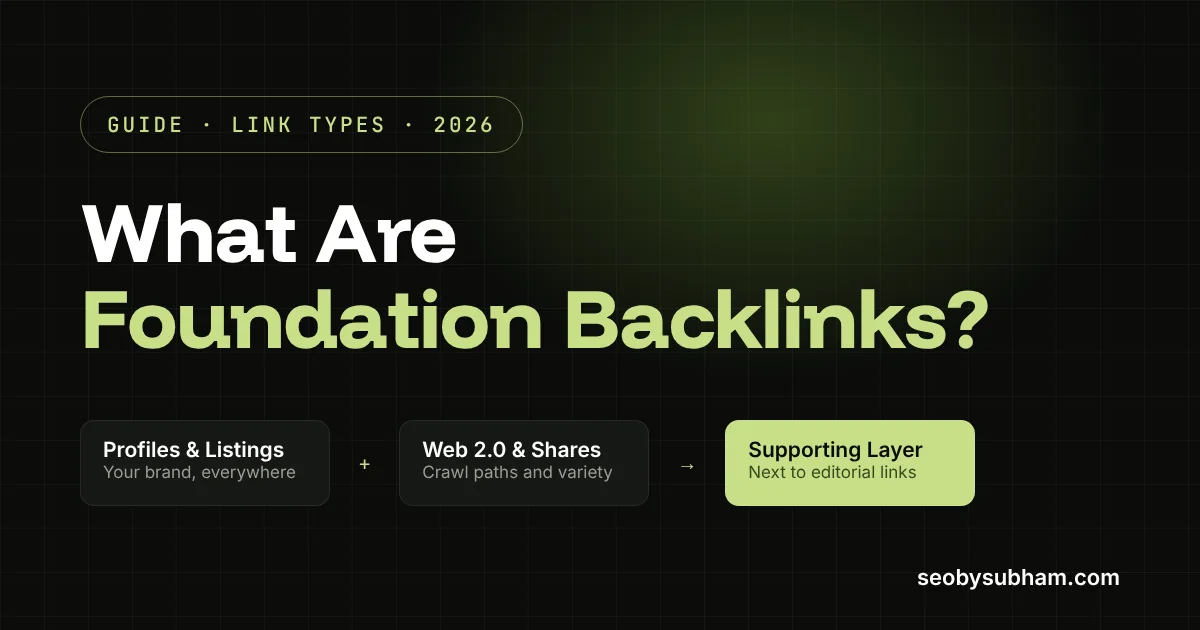
Foundation backlinks (also called foundational links or foundation links) are basic links from places where any business can list itself: business and social profiles, directories and citations, Web 2.0 blogs, and document or media shares. They confirm your brand and give Google more paths to your site, but they don’t rank a competitive page on their own.
Rankings come from editorial links on relevant sites, and foundation links are the supporting layer around them. Done well, building them means complete, consistent profiles on platforms real people use, built by hand over weeks with your brand name or URL as the anchor. Done badly, it means hundreds of thin profiles made by software in a few days, which is exactly what Google’s link spam policy describes.
I’m Subham Chowdhury. I’ve worked in SEO since 2014 and built links for clients since 2018, and foundation links are part of every monthly plan I sell at SEO by Subham. This guide is how I explain them to clients before anyone pays: what they are, what they’re worth and where they stop being worth it.
What Counts as a Foundation Link, and What Doesn’t
Definitions vary. Some sellers call guest posts and niche edits “foundation links”, others only mean profiles. The line I use is simple: if you can create the link yourself by signing up somewhere, it’s a foundation link. If an editor or site owner has to agree to publish it, it’s an editorial link.
| Link type | Who places it | Main job | Examples |
|---|---|---|---|
| Foundation links | You, by creating a profile or listing | Brand signals, crawl paths, a varied profile | Business profiles, directories, social profiles, Web 2.0 blogs |
| Editorial links | A site owner or editor | Ranking value and topical relevance | Guest posts, niche edits, digital PR mentions |
| Tier 2 links | You or a seller | Point at your other links, not at your site | Links pointing to a guest post or a Web 2.0 blog |
| Pillow links | You | An older name for much the same thing as foundation links | Profiles, comments and bookmarks used to “cushion” stronger links |
The distinction matters when you buy. A package of “200 foundation links” and a package of two guest posts are different products, with different prices and very different ranking value. If you’re new to the link types, my guide to what link building is explains each one.
Types of Foundation Backlinks
Most foundation links fall into six groups. Many of them are nofollow, which is normal: their value is mostly in the brand signal and the crawl path, not in passing ranking credit.
- Business and brand profiles. Company pages and founder profiles on sites such as Crunchbase, about.me and LinkedIn. They describe who you are and link to your site.
- Directories and citations. Industry directories (Clutch and GoodFirms for agencies, for example) and, for local businesses, citations with the same name, address and phone number everywhere.
- Social profiles. X, Facebook, Pinterest, Instagram and YouTube. Their links are almost always nofollow, but they’re part of how Google and people recognize a brand.
- Web 2.0 blogs. Short articles on free blogging platforms that link to your site. I tested 21 of these platforms for dofollow and indexing in my guide to Web 2.0 backlinks.
- Document, image and video shares. PDFs, slide decks, infographics and videos on sharing sites, with a link in the description.
- Forum and Q&A profiles. Profiles on communities like Quora or industry forums. The profile link is the foundation link. A genuinely helpful post that mentions your site can be fine, but Google names “forum comments with optimized links in the post or signature” as link spam, so keep keyword anchors out of posts and signatures.
A Sample of Foundation Link Platforms I Use
These are 26 of the platforms I use for clients’ foundation links, with each platform’s Moz Domain Authority, checked in October 2026. It’s a sample: my full list is longer and stays private, so it doesn’t get copied and overused.
| Platform | Type | DA (Moz) |
|---|---|---|
| adobe.com | Portfolio profile | 97 |
| mozilla.org | Community profile | 97 |
| sites.google.com | Web 2.0 site | 96 |
| gravatar.com | Brand profile | 96 |
| medium.com | Web 2.0 blog | 95 |
| slideshare.net | Document share | 95 |
| 4shared.com | File share | 94 |
| issuu.com | Document share | 94 |
| pixabay.com | Image share | 94 |
| soundcloud.com | Audio profile | 94 |
| wordpress.com | Web 2.0 blog | 94 |
| academia.edu | Document share | 93 |
| disqus.com | Community profile | 93 |
| goodreads.com | Community profile | 93 |
| groups.google.com | Forum and group | 93 |
| kickstarter.com | Brand profile | 93 |
| linktr.ee | Link-in-bio profile | 93 |
| netlify.com | Web 2.0 site | 93 |
| ted.com | Community profile | 93 |
| twitch.tv | Video profile | 93 |
| about.me | Brand profile | 92 |
| comicvine.gamespot.com | Community profile | 92 |
| mixcloud.com | Audio profile | 92 |
| blogger.com | Web 2.0 blog | 91 |
| strikingly.com | Web 2.0 site | 86 |
| hackmd.io | Document share | 71 |
Read the DA column for what it is: the platform’s score, not your profile’s. A new profile on a DA 95 site starts with almost no authority of its own, which is why the platform matters less than whether the profile is complete, branded and on a site people use. Some of these platforms give dofollow links and some nofollow, and that changes over time, so I check every link when I build it and record it in the client’s report.
What Foundation Links Do, and What They Don’t
Foundation links do four useful things:
- Confirm your brand. The same name, URL and description across trusted platforms helps search engines connect the dots about who you are. This matters more as AI answers grow: in an Ahrefs study of 75,000 brands, branded web mentions correlated more strongly with appearing in AI Overviews (0.664) than backlinks did (0.218). That’s a correlation, not proof, but consistent brand profiles are part of it.
- Give Google paths to a new site. A brand-new domain has few links for crawlers to follow. A handful of profiles on sites Google crawls often can help it find you sooner.
- Add variety. Most established businesses have profiles and listings, so a link profile made only of guest posts looks thin. Adding hundreds more profiles won’t make it look more natural, though.
- Send visitors, sometimes. A Clutch profile for an agency or a local directory for a plumber can bring enquiries on its own, regardless of SEO.
And three things they don’t do:
- Rank a competitive keyword on their own. If the pages above you have links from relevant editorial sites, a pile of profiles won’t close that gap.
- Pass the platform’s authority to you. A profile on a DA 90 site doesn’t give your site DA 90. The authority belongs to the platform, and a new profile page starts with almost none of its own. My guide to high authority backlinks explains why.
- Fix a weak page. If the page you want to rank is thin or doesn’t match what searchers want, no type of link will hold it up.
When Foundation Links Are Worth Building
| Situation | Worth it? | Why |
|---|---|---|
| New website, under a year old | Yes | It has almost no links, so profiles give it a base and crawl paths while editorial links take time to land |
| Local business | Yes | Consistent citations help customers and search engines confirm your name, address and phone number |
| New brand name or rebrand | Yes | Profiles under the new name help it get recognized |
| Established site with hundreds of referring domains | Rarely | The base already exists; editorial links will move rankings far more |
| Competitive keyword, no editorial links yet | Only alongside outreach | Foundation links alone won’t close the gap |
How Many Foundation Links Do You Need?
For most small sites, 50 to 120 foundation links a month is enough, as long as they sit next to 1 to 4 outreach links on niche sites. That’s the range my monthly plans build. Start with the profiles and directories that matter for your type of business and country, the ones a customer might look at, then add the rest gradually rather than in one big batch.
That ratio is deliberate: the outreach links do the ranking work, the foundation links support them. Sellers offering 500 or 1,000 foundation links in a few days are describing a pattern, not a foundation.
For a method to size the whole link gap between you and the pages ranking above you, see my guide on how many backlinks you need.
How to Build Foundation Links Safely
This is the process I follow for clients. It works the same whether you do it yourself or hire someone.
- Write your brand details once. Exact business name, URL, a short and a long description, logo and, for local businesses, address and phone number. Reuse them word for word.
- Start with the platforms your customers use. Your industry’s main directories and the big brand profiles come first. Obscure directories in other countries come last, or never.
- Complete every profile. Logo, description, accurate details. Empty profiles look like spam, and platforms delete them.
- Use your brand name or URL as the anchor. Keep keyword anchors rare. A profile that links to “cheap plumber London” tells Google exactly what it is. My anchor text guide covers which anchors suit which kind of link.
- Spread them over weeks. Build a few at a time and mix them with editorial links, so your profile grows the way a growing business’s does.
- Record and recheck every link. Keep the URL, date, platform, anchor and whether it’s dofollow or nofollow. Check again after a month: some profiles get removed or never get indexed.
- Skip automated tools. Software that creates hundreds of accounts is the fastest way to turn a harmless tactic into a spam pattern.
Connect Your Profiles to Your Brand With sameAs
Once your main profiles are live, list them on your website too, in the Organization schema on your homepage, using the sameAs property. Google’s documentation describes sameAs as “the URL of a page on another website with additional information about your organization”, and says Organization markup can help it disambiguate your organization in search results. It turns a scattered set of profiles into one connected brand that search engines and AI tools can read directly.
<script type="application/ld+json">
{
  "@context": "https://schema.org",
  "@type": "Organization",
  "name": "Your Brand",
  "url": "https://yourbrand.com/",
  "sameAs": [
    "https://linkedin.com/company/yourbrand",
    "https://clutch.co/profile/yourbrand",
    "https://about.me/yourbrand"
  ]
}
</script>
Only list profiles you control, that use the same business name and link back to your site. On seobysubham.com, the homepage lists 14 profiles this way, including LinkedIn, Clutch, Trustpilot, Quora and about.me.
Foundation Link Risks and Red Flags
Google’s link spam policy lists, among other things, “using automated programs or services to create links to your site”, “low-quality directory or bookmark site links” and forum comments with optimized links. That’s the honest risk with foundation links: the tactic itself is fine, but the cheap, automated version of it is exactly what the policy describes. Most of the time those links are simply ignored. At scale, they can do worse.
Walk away from any seller or package showing these signs:
- Hundreds of links delivered in a day or two. Manual work takes time. Speed like that means software.
- “100% safe” or “Google-friendly” promises. No one can promise that about any link.
- The same spun description on every profile. Easy for anyone, including Google, to spot.
- Keyword anchors everywhere. Profiles named after your target keyword instead of your brand.
- “DA 90+ backlinks” as the main selling point. The DA is the platform’s, not your profile’s.
- No report. If you can’t open and check every link, you can’t tell what was built in your name.
If you already have a batch of spammy profile links from the past, don’t panic. Google usually ignores them. Stop building more, and only consider a disavow file if you’ve had a manual action or the links follow an obvious spam pattern. My guide on how to choose a link building service covers the wider checks to run before you hire anyone.
What Foundation Backlinks Cost
Foundation links are the cheapest link type, because most platforms are free and the work is setup rather than outreach. Published package prices, checked in October 2026:
| Seller | What you get | Price |
|---|---|---|
| Vettted | 50 or 100 foundational links | $39 or $79 Source |
| Shrushti Digital | 60 foundational links | $59 Source |
| SEO by Subham (one-time) | 100, 220 or 450 links on Web 2.0, bookmarking, PDF and profile sites, added over 2 to 4 weeks | $60, $110 or $200 (see packages) |
| SEO by Subham (monthly) | 50 to 120 foundation links a month, plus outreach links and Web 2.0 blogs | Plans from $50 a month (see plans) |
That works out to roughly 40 cents to $1 per link. At those prices, nobody is spending long on each profile, so the questions that matter are whether the work is manual, whether descriptions are unique and whether you get a report of every link. Doing it yourself costs nothing but time, and a complete profile takes longer than most people expect.
How I Build Foundation Links for Clients
- By hand, at a sensible pace. 50, 85 or 120 foundation links a month on the Starter, Growth and Authority plans, always alongside outreach links and Web 2.0 blogs. For a new site that only needs a base, my one-time packages add them over 2 to 4 weeks, never in a day.
- Brand first. I agree your brand details and anchor mix before work starts, and most foundation links use your brand name or URL.
- A natural mix. Some links are dofollow and some nofollow, because that’s what normal profiles look like.
- Every link reported. A shared Google Sheet updated daily, and a full Excel report at the end of the month. You can see a sample report (PDF) before you buy.
- A private platform list. I use many more platforms than the sample above. The full list stays private so it doesn’t get copied and overused.
If that’s the kind of base your site needs, here are my manual link building services and monthly plans.
Frequently Asked Questions
Short answers to the questions people ask most about foundation backlinks.
Do foundation backlinks still work in 2026?
Yes, for what they’re meant to do: confirm your brand, give a new site crawl paths and fill out a thin link profile. They don’t rank competitive pages on their own, and mass-produced ones are mostly ignored. Used as a supporting layer next to editorial links, they still have a place.
Are foundation backlinks safe?
Built by hand on platforms people actually use, with complete profiles, brand anchors and a sensible pace, the risk is low. The risky version is automated: hundreds of thin profiles in a few days, which Google’s link spam policy describes directly.
Are foundation links dofollow?
Some are, many aren’t. Social profiles are almost always nofollow, while some directories, profiles and Web 2.0 blogs pass dofollow links. It varies by platform and can change, so check each link with your browser’s Inspect tool and record it. A mix of both is normal.
Do nofollow foundation links help?
Yes, but not by passing much ranking credit. A nofollow profile still confirms your brand details, can send visitors and gives Google a path to your site. Google treats nofollow as a hint rather than a strict rule, but build these links for brand consistency, not ranking power.
Is buying foundation links against Google’s rules?
It isn’t illegal, and paying someone to set up complete profiles by hand is a service. Google’s concern is links made by automated programs and low-quality directory or bookmark links. Judge a package by how the links are made, not by who makes them.
How much do foundation backlinks cost?
Published packages run from about 40 cents to $1 per link, for example $39 for 50 links or $59 for 60. Building them yourself is free apart from your time.
Can I build foundation links for free?
Yes. Nearly every profile, directory and Web 2.0 platform is free to join. The cost is time: writing descriptions, adding logos, confirming emails and keeping a record of every link.
Are foundation links better than guest posts?
No, they do different jobs. One relevant guest post on a site with its own readers usually outweighs hundreds of profiles for rankings. Foundation links support editorial links; they don’t replace them.
How long do foundation links take to get indexed?
Profile pages are often crawled slowly, and some are never indexed at all, which is why it pays to keep a report and recheck after a month. My guide on how long backlinks take to work covers the full timeline.
Should a new website start with foundation links?
It’s a sensible first step, as long as it isn’t the only one. Set up the core profiles and directories in the first weeks, then add editorial links as soon as the site has pages worth linking to.
The Bottom Line
Foundation backlinks are the base layer of a link profile: profiles, listings and Web 2.0 blogs that confirm your brand and give Google paths to your site. Build them by hand, keep them consistent and branded, spread them over time, and pair them with editorial links. That’s where the ranking value comes from, and it’s how manual link building campaigns are put together.
If you’re comparing link types, start with what link building is and how to get backlinks. For timing, see how long backlinks take to work.

Send Me Your Website
Tell me your site and the page you want to rank. I’ll tell you which profiles and directories matter for your business, and whether foundation links are worth it for you at all, before you pay anything.