How Many Backlinks Do I Need? The Short Answer
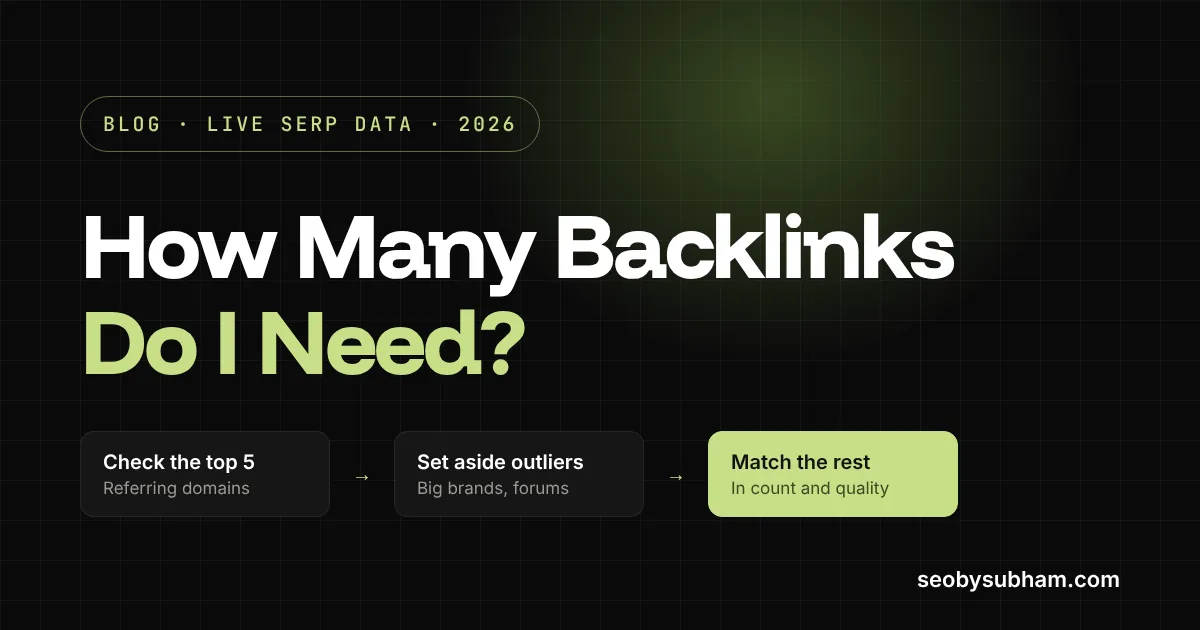
How many backlinks you need depends on the pages you're up against. Look at the top 5 results for your keyword, note how many different websites link to each ranking page, set aside pages that rank because their whole domain is huge, and aim for the middle of the rest, from sites at least as relevant as theirs. In the three keywords I checked for this post, that bar was under 10 referring domains.
How many backlinks do I need? There's no single number, and a figure given without looking at your keyword is a guess. What you can work out, in about five minutes, is how many your keyword needs. This post shows you the method step by step, then applies it to three keywords using Semrush data I pulled in October 2026. One of them is the exact question you typed into Google. The page ranking first for it has one referring domain.
I'm Subham Chowdhury. I've worked in SEO since 2014 and built links for clients since 2018, and this is the same check I run before I quote any campaign.
Backlinks vs Referring Domains: Count the Right Thing
Most backlink tools show two numbers, and the bigger one is the less useful.
- Backlinks are every individual link. One site with a link in its sidebar can add thousands of them overnight.
- Referring domains are the number of different websites linking to you. Ten links from one site still count as one referring domain.
When people ask how many backlinks they need, the number that matters is referring domains to the page you want to rank, from sites that are relevant and have their own traffic. A page with 40 links from 40 related sites is in a very different position from a page with 4,000 links from 3 sites. If you're new to the basics, my guide to what link building is explains how links pass value.
So for the rest of this post, “links” means referring domains unless I say otherwise.
How to Work Out Your Number in 5 Minutes
You can do this with Semrush, Ahrefs or a free backlink checker. The steps are the same.
- Pick one keyword and one page. The number is different for every keyword, so don't try to work out a site-wide figure.
- Open the top 5 organic results. Skip ads, maps, videos and “People also ask” boxes. You want the five normal listings.
- Note the referring domains to each ranking page. Count the links to the page itself (the exact URL), not the whole website, and only count dofollow links from sites with their own traffic. Note the site's overall strength too (Authority Score in Semrush, DR in Ahrefs). You'll need both in step 4.
- Note why each page ranks. If it's Reddit, Quora, YouTube, Amazon, Wikipedia or a big marketplace, the page usually ranks on the strength of the whole domain and the format Google wants to show. Mark it, but don't copy its link count.
- Set aside the outliers. One page with ten times more links than the others is usually ranking for many keywords at once. It shouldn't set your target.
- Take the middle of what's left. That's your rough target. Subtract the referring domains your page already has.
- Check the quality of their links, then the count. Open a few. Are they from sites on the same topic, with their own traffic, placed inside an article? If your competitors have 8 links from relevant blogs, 8 links from random directories won't match them.
It helps to put this in a simple table:
| Position | URL | Ref. domains to page | Site strength | Why it ranks | Keep or set aside |
|---|---|---|---|---|---|
| 1 | |||||
| 2 | |||||
| 3 | |||||
| 4 | |||||
| 5 |
Two shortcuts help before you start. Most tools show a keyword difficulty score (this keyword is KD 16 in Semrush). It's a useful first filter, but it's built from link counts across the whole of page one, so it can't tell you which pages are outliers. And check your own internal links first: linking to your target page from your stronger pages costs nothing and sometimes closes part of the gap.
The quality check in step 7 is where most of the work is. Two pages with the same link count can be miles apart in strength. My guide to high authority backlinks covers how to judge a linking site in more detail.
How Many Backlinks Top-Ranking Pages Have: 3 Live Examples
These are page-level referring domains from Semrush (US database), checked on 17 October 2026. Search results move every week, so treat them as a snapshot. Semrush's index also misses some links, so the true counts can be a little higher. The pattern is what matters.
Example 1: “how many backlinks do I need” (low competition)
| Position | Ranking page | Ref. domains to page |
|---|---|---|
| 1 | Reddit thread (r/SEO) | 1 |
| 2 | Online Optimism blog post | 1 |
| 3 | YouTube video | 4 |
| 4 | Quora question | 0 |
| 5 | FatJoe blog post | 1 |
The page ranking first for this exact question has one referring domain. Reddit, YouTube and Quora rank on the strength of their domains, so set them aside. The two blog posts have one link each.
What that tells you: for a keyword like this, the page that answers the question best has a fair chance with only a few links from relevant sites. Content will decide most of the race.
Example 2: “web 2.0 backlinks” (mixed competition)
| Position | Ranking page | Ref. domains to page |
|---|---|---|
| 1 | PressWhizz list post | 6 |
| 2 | SirLinksALot list post | 78 |
| 3 | Reddit thread | 1 |
| 4 | BeeMarketing list post | 1 |
| 5 | Rankers Paradise guide | 580 |
This one looks harder at first: 78 and 580. But the page in first place has 6, and the page in fourth has 1. The 580-link page sits in fifth, below pages with a fraction of its links, so link count clearly isn't the only thing deciding the order.
What that tells you: set aside the two outliers and Reddit, and the realistic bar is in single figures, as long as the content is the best answer on the page. (Full disclosure: I'm targeting this keyword myself with my Web 2.0 backlinks guide.)
Example 3: “link building services” (commercial, competitive)
| Position | Ranking page | Ref. domains to page |
|---|---|---|
| 1 | PeoplePerHour category page | 0 |
| 2 | UK Companies House listing | 0 |
| 3 | Reddit thread | 0 |
| 4 | Local agency page (Los Angeles) | 1 |
| 5 | List of link building providers | 9 |
| 12 | Linkbuilder.io homepage | 1,092 |
You'd expect the biggest link profiles to win a commercial keyword like this. Instead, the top five ranking pages have between 0 and 9 referring domains, while a page with 1,092 sits in twelfth.
What that tells you: for some keywords, links to the page aren't the main factor at all. Google is showing marketplaces, a forum and local results because it's unsure what the searcher wants. A strong domain (PeoplePerHour, Reddit) can rank a page with no links of its own. This page one also looked unusually unsettled when I checked: a company register listing in second place is a sign Google is still testing results. Counting links alone would give you the wrong answer here, which is why step 4 of the method matters.
What Changes How Many Backlinks You Need
The same keyword can need very different numbers for two different sites. These are the factors that move it most:
- How strong your whole site is. A page on an established site starts with authority from the site's internal links. A page on a new site starts with almost none, so it usually needs more links of its own.
- How good and how relevant the page is. Links help a page that already deserves to rank. They rarely rescue a thin page or one that doesn't match what searchers want.
- What Google wants to show. If page one is all forums, videos or marketplaces, more links to a blog post may not move it. Check the format first.
- How relevant the linking sites are. Five links from sites in your niche usually do more than twenty from unrelated ones.
- How competitive the topic is. Money keywords in finance, legal or software attract link-building budgets. Informational questions in small niches often don't.
How Many Backlinks Should a Website Have?
People often ask for a site-wide number. It's the wrong target, for the same reason as above: Google ranks pages, not websites. Still, a few patterns are useful:
- Your homepage collects most of your brand links naturally: directory listings, mentions, partners, press. It rarely needs a separate target.
- Money pages (services, products, category pages) are where a planned link target makes sense. Check your top 3 money pages with the method above and give each its own target.
- Blog posts that answer questions often rank with few or no links if the content is strong, then pass authority to your money pages through internal links.
- A new website usually gets further by putting its first links into a few key pages than by spreading them thinly across every page.
How Many Backlinks Per Month (or Per Day) Is Safe?
Google doesn't publish a safe number, and there isn't one. Its spam policies are about how links are acquired, not how fast. Buying links meant to pass ranking credit and “using automated programs or services to create links to your site” are both named as link spam. A news story that picks up 50 links in a day is normal. Fifty software-made links in a day is the pattern Google's policy describes.
What pace looks like in practice:
- Editorial links (people linking because they want to) arrive unevenly, and that's normal.
- Links you build by outreach should follow the work: a few a month for a small site, more as the site and content grow.
- For reference, my own monthly link building plans add between 1 and 4 outreach links a month to one page, alongside Web 2.0 blogs and foundation links. That's a pace that suits most small and mid-sized sites, not a rule.
If someone offers “500 backlinks in 7 days”, the pace isn't the only problem. Links delivered that fast are almost always automated.
Can You Have Too Many Backlinks?
Not in the sense of a count. Large sites have millions. What causes trouble is large numbers of low-quality or manipulative links: link networks, spun articles, hacked pages or unrelated sites, often with the same exact-match anchor text.
Google says that in most cases it can work out which links to trust without your help, and it suggests disavowing links only when you have a lot of spammy links that caused, or are likely to cause, a manual action. So a few odd links pointing at your site are not something to worry about.
How to Check How Many Backlinks You Have
- Google Search Console (free): the Links report shows your top linking sites and your most linked pages. It isn't a complete list, but it's Google's own data.
- Ahrefs Webmaster Tools (free for sites you own): shows referring domains and backlinks once you verify your site.
- Semrush or Ahrefs (paid): let you check any site, including competitors, which you need for the method above.
Each tool crawls the web differently, so the counts won't match. Pick one tool and use it for both your site and your competitors, so you're comparing like with like.
Is It Worth Paying for Backlinks?
It can be, if you're paying for good work: research, writing and outreach to relevant sites. Know the trade-off, though. Google's guidelines ask for paid links to be marked rel="sponsored" or rel="nofollow", and links bought mainly to manipulate rankings can break its spam policies. The risk comes from patterns: bulk packages, irrelevant sites, the same keyword anchor on every link. For a safer split, see the anchor text ratios of pages that rank today.
If you're comparing sellers, my guide on how to choose a link building service lists the checks to run before you pay anyone, including me. For the wider picture of free and paid methods, see how to get backlinks.
Frequently Asked Questions
Short answers to the questions people ask most about how many backlinks they need.
What is a good number of backlinks?
A good number is enough referring domains to match the pages already ranking for your keyword, from sites at least as relevant as theirs. For many low-competition keywords that's under ten. For competitive commercial terms it can be dozens. Check your keyword's top 5 results rather than relying on a general figure.
How many backlinks do I need to rank on the first page?
Use the method above on your keyword's page one. In all three examples here, once outliers were set aside, the bar was under 10 referring domains.
How many high-quality backlinks do I need?
Fewer than most people expect. A handful of links from relevant sites with their own traffic usually does more than dozens of low-quality ones. Match the quality of your competitors' best links first, then their count.
How many backlinks should a blog have?
There's no target for a blog as a whole. Many blog posts rank with few or no links when they answer the question well. Focus links on the posts that target competitive keywords, and link from your blog posts to your service pages.
Can you rank without backlinks?
For low-competition keywords, often yes, especially on a site with some existing authority. For anything competitive, a page usually needs at least a few links from relevant sites.
Are backlinks still relevant in 2026?
Yes. Google still uses links to discover pages and as one signal of which pages are useful. What has changed is that relevance and how links were acquired matter more than raw numbers.
So, How Many Backlinks Do You Need?
Don't chase a number someone else picked. To find how many backlinks you need, take your keyword, look at what the top 5 pages have, set aside the outliers and match the quality of the rest. You'll usually find you need fewer links than you feared, as long as they come from the right sites. Then give them time: most links take weeks to months to show, as I explain in how long backlinks take to work.
If you'd rather have someone run this analysis and build the links for you, I offer manual link building services with a daily report of every link, and I'll tell you honestly how many links your keyword needs before you pay anything.

Send Me Your Keyword
I'll check the pages you're up against and tell you how many links your page needs, and which kind, before you pay anything. If you go ahead, every link goes into a report you can check.