How to Get Backlinks: The Short Version
The most reliable way to get backlinks is to have pages other sites genuinely want to reference, then put them in front of the right people: through outreach, guest posts, journalist requests, broken link replacements and the sites that already link to your competitors. Free methods work but take time. Paid help saves time, but paying a site for a link that passes ranking credit breaks Google's rules.
That's the honest summary. The rest of this guide is the detail most articles skip: which methods suit which situation, what links actually cost in 2026, how many you need, how long they take to show results, and why some links never seem to count at all.
I'm Subham Chowdhury, founder of SEO by Subham, and I've been building links since 2014, first in an agency team and then on my own, with more than 2,000 link building orders completed for clients. Everything below comes from that work, not from a list of tactics copied between blogs. If you're new to the subject, my guide on how link building works covers the basics first.
Before chasing links, make sure the page you want links for deserves them. Outreach for a thin page wastes weeks. It's the first thing I check before taking on a client: if the page they want links for is thin, I say so and suggest improving it first, because no editor will link to it and it won't hold a ranking even if they do.
1. Do Backlinks Still Matter in 2026?
Yes. Links from other sites are still one of the main ways Google judges which pages deserve to rank. Google discovers new pages by following links, and its own page on how results are ranked explains that when other prominent websites link or refer to a page, it's generally a good sign the information is trustworthy.
What has changed is which links help. Ten years ago, volume could carry a weak page. Today, a handful of relevant links from real sites usually does more than hundreds of random ones, and the random ones can drag you down.
There's also a newer reason to care. AI answers in Google, ChatGPT and Perplexity tend to cite pages that other trusted sites already reference and mention. A brand that keeps appearing on relevant, respected pages is easier for those systems to recognise as an authority on its topic.
So the question isn't whether to get backlinks. It's how to get the kind that help without creating risk.
2. What Makes a High-Quality Backlink
A backlink is worth getting when it comes from a relevant page on a real site that people actually visit, placed inside the content where a reader would click it. Authority scores like DA or DR help you filter, but they don't decide quality on their own.
| Check | Strong link | Weak or risky link |
|---|---|---|
| Topic | Same or closely related subject | Unrelated niche, or a site about everything |
| Traffic | Steady organic visitors over time | High DA but almost no real traffic |
| Placement | Inside the main text, in context | Footer, sidebar, long list of links |
| Anchor text | Natural wording, brand or partial match | The same exact keyword every time |
| The site's own links | Links out sparingly, to useful sources | Every post links to casinos, loans, CBD |
| "Write for us" page | Editorial guidelines, rejects weak pitches | Price list for "DA 50 dofollow posts" |
Taken together, all the links pointing to your site make up your backlink profile. Google looks at that profile as a whole. A natural one grows steadily, comes from many different sites, and uses varied anchor text, because real people describe your page in their own words.
The Traffic Check I Run Before Any Pitch
Before a site goes on a client's shortlist, I look at its organic traffic over time in Semrush, along with its Trust Flow and the quality of its own backlinks. A site that lost most of its traffic after a Google update is a red flag, whatever its authority score says. A link from a site Google has stopped trusting rarely helps you.
3. Free Ways to Get Backlinks (Start Here)
You can get backlinks for free by turning brand mentions into links, replacing broken links, getting listed on resource pages, answering journalist requests and creating something worth citing. None of these cost money. They cost time, and for a new site they are also the safest way to create backlinks that last.
Turn unlinked brand mentions into links
Some sites already mention your business, product or name without linking to you. They know who you are, so a short, polite email asking them to add a link often works.
- Search Google for
"Your Brand" -site:yourdomain.comand skip social profiles. - Set up a free Google Alert for your brand and your own name.
- Email the writer, thank them for the mention, and suggest the exact page to link.
Best for: businesses that already get some press, reviews or mentions. Weak for: brand-new sites nobody has written about yet.
Broken link building
Find pages in your niche that link to something that no longer exists, then offer your page as the replacement. The site owner gets a fix, their readers get a working link, and you get the link.
- Pick a competitor or a big site in your niche and look for its broken pages with the most backlinks (Semrush and Ahrefs both have a "broken pages" report).
- Check what the dead page used to say on the Wayback Machine.
- Make sure you have a page that covers the same thing, or a better one.
- Email the sites that still link to the dead page.
Replies are slower than people expect, but the links you do win are usually editorial and long-lasting.
Get listed on resource pages
Many sites keep curated pages of recommended tools, guides or local businesses. Search for your topic + "useful resources" or your topic + intitle:resources, check the page is still maintained, and suggest your page with one sentence on why it fits their list.
Answer journalist and blogger requests
Writers post requests for expert quotes every day on platforms like HARO (now run by Featured), Qwoted, Featured and SourceBottle. A selected answer can land a link from a site you could never reach through cold outreach.
- Answer fast: early replies get read first.
- Answer only what you know: one specific insight beats three generic tips.
- Show why you're qualified: one line, not a sales pitch.
Expect most pitches to go unused. The ones that land tend to be the strongest links you'll earn all year.
Podcasts and expert interviews
Niche podcasts and interview series need guests constantly. Most publish show notes with a link to the guest's site. Pitch a specific topic you can speak on, not just "I'd love to be on your show."
Create something worth citing
People link to things they can't easily make themselves: original data, a free tool, a clear checklist, a calculator. On this site, the free meta title and description checker and the FAQ schema generator exist for exactly that reason. They help people, and helpful tools get shared and referenced.
You don't need a big budget. A simple page answering a common question in your industry with real numbers from your own work can earn links for years.
Business profiles and foundation links
New websites should have the basics in place: Google Business Profile, relevant industry directories, social profiles and a few well-made Web 2.0 properties. These links are weak on their own and won't push a competitive page to page one. Their job is to make a new brand look real and give Google more paths to find your site.
4. How to Build Backlinks That Move Rankings Faster
These three methods take more effort, or some budget if you hire help, but they're where most competitive rankings are won. They give you more control over where your link appears and which page it points to.
Guest posting, done properly
Guest posting means writing a genuinely useful article for another site in your niche, with a link back to a relevant page on yours. It still works in 2026, as long as it isn't done at scale on sites that publish anything for money.
- Find sites: search
your topic + "write for us"or"guest post guidelines", then check traffic and topic fit. - Pitch ideas, not yourself: two or three titles their readers would want, based on gaps in what they've already published.
- Write to their standard: the article should be good enough that they'd publish it without your link.
- Link where it helps the reader: one contextual link to a relevant page, not your homepage with a keyword anchor.
When I run custom guest post outreach for clients, most of the time goes into research and pitching, not writing. Finding sites with real readers in the right niche is the hard part. Clients see and approve every proposed site and topic before I write anything, so nothing goes live on a site they haven't agreed to.
Niche edits (link insertions)
A niche edit is a link added to an article that already exists and is already indexed. Because the page already has age and sometimes its own backlinks, these links can take effect faster than a brand-new guest post.
The honest catch: many niche edits are sold, not earned. A site owner who adds your link because it improves their article is fine. A site that sells link insertions on every old post for a fixed price is exactly the pattern Google's link spam rules describe. Judge each opportunity by whether the link genuinely helps that page's readers.
Find your competitors' backlinks and earn similar ones
If a site links to three of your competitors, there's a good chance it would link to you too. This is the most practical way to build a target list.
- Put your site and three to five competitors into a backlink gap tool (Semrush Backlink Gap or Ahrefs Link Intersect).
- Filter for sites that link to at least two competitors but not to you.
- Open each page and ask how the competitor got there: a guest post, a "best tools" list, a resource page, an interview.
- Use the same route with a better reason to include you.
On a free budget, Google Search Console only shows your links. For competitors, the free versions of Ahrefs and Semrush show a limited sample, which is enough to spot patterns.
5. Which Method Should You Use?
Pick methods based on where your site is now and what you have more of: time or budget. Trying everything at once usually means doing nothing well.
| Your situation | Start with | Effort | Cost |
|---|---|---|---|
| Brand-new site, no links | Business profiles, resource pages, journalist requests | Low to medium | Free |
| Local business | Local directories, suppliers, local news, sponsorships | Low | Free to low |
| Established brand with press | Unlinked mentions, journalist requests, podcasts | Low | Free |
| Blog or affiliate site stuck on page 2 | Competitor gap, guest posts, broken links | High | Free to medium |
| SaaS or tool | "Best tools" lists, integrations, free tools | Medium | Free to medium |
| Business owner with no time | Hire a link builder for outreach and guest posts | Low (for you) | Medium |
6. Is It Worth Paying for Backlinks?
Paying for work is fine. Paying a website for a link that passes ranking credit is not. Google's spam policies list "buying or selling links for ranking purposes" as a link scheme, and sites caught doing it can lose rankings or have their links ignored.
This is the part most "how to get backlinks" guides either skip or reduce to one line, so let me be specific about the difference.
Paying for Time and Skill
- Outreach work: someone researches sites and pitches them for you; the editor still decides.
- Content creation: paying a writer for a guest article or a linkable asset.
- Labelled sponsorships: paid placements marked
rel="sponsored"ornofollow, bought for traffic and visibility.
Paying for Rankings
- Private blog networks (PBNs): sites built only to sell links.
- "1,000 backlinks for $20": automated links on spam pages.
- Price lists by DA: sites selling dofollow links on any topic to anyone.
When clients ask me about this, I put it simply: you can pay someone to do the work of earning a link, but the link itself should be there because the publisher thinks it helps their readers. If the only reason a link exists is money, assume Google can work that out eventually.
8 red flags when hiring a backlink seller
- Guaranteed rankings or a promised position on Google.
- Hundreds of links delivered in a few days.
- No sample sites or a refusal to show past placements.
- DA is the only metric they talk about.
- The same site list offered to every niche.
- Exact-match anchors on every link by default.
- No report with live URLs you can check yourself.
- No refund or replacement if a link disappears.
What a proper backlink report looks like
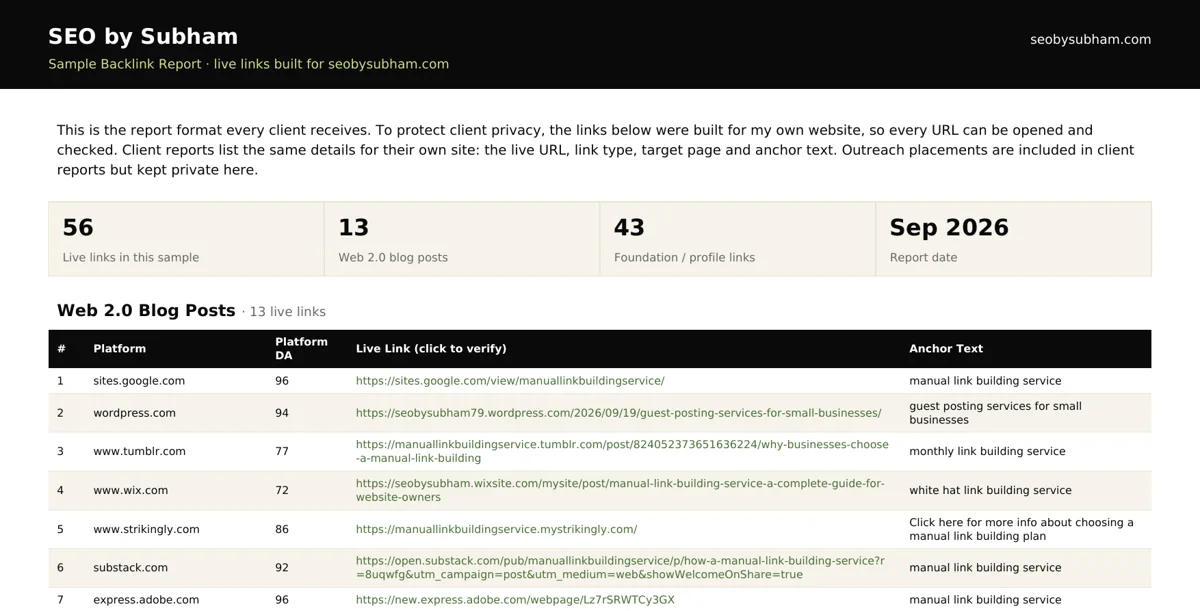
Every order I deliver ends with a report listing each live URL, the page it points to and the anchor text, so you can open and check every link yourself. This sample uses links built for my own site:
7. How Much Do Backlinks Cost in 2026?
A single quality backlink through outreach or guest posting usually costs somewhere between $80 and $500 in 2026, depending on the site's traffic, niche and editorial standards. Links on major publications can cost far more, and cheap bulk links cost almost nothing because they're worth almost nothing.
| Type | Typical range | What drives the price |
|---|---|---|
| Foundation links (profiles, Web 2.0) | $50 to $200 per package | Manual work and number of platforms |
| Niche edit on a relevant site | $60 to $300 per link | Page traffic and age |
| Guest post on a niche blog | $80 to $500 per link | Site traffic, niche, content included |
| Guest post on a major publication | $500 to $2,000+ per link | Brand name, strict editorial review |
| Monthly link building service | $300 to $5,000+ per month | Number and quality of links, reporting |
| Digital PR campaign | $3,000 to $15,000+ per campaign | Research, data, journalist outreach |
For a wider market view, BuzzStream's 2026 guest post pricing study of 257,267 sites found an average vendor price of $461 per guest post, and that about 78% of the sites selling posts get fewer than 1,000 organic visits a month. Price alone tells you very little; traffic and relevance decide whether a link is worth it.
Prices go up in competitive niches like finance, legal and health, where fewer sites accept outside contributors. Some niches, such as casino, CBD and adult, are expensive and risky; I don't take them on at all.
For reference, the monthly packages at SEO by Subham start at $50, and one-time high authority backlink packages start at $60. Both come with a full report of every live URL, so you can check each link yourself.
8. How Many Backlinks Do You Need?
There's no universal number. You need roughly as many relevant referring domains as the pages already ranking for your keyword, and the only honest way to know that number is to check them.
Here's the four-step method I use before quoting any campaign:
- Search your target keyword and note the top five ranking pages, ignoring giant brands you can't realistically match.
- Check referring domains (unique linking websites) for each of those pages, not the whole domain. Free backlink checkers from Ahrefs or Semrush are enough for this.
- Take the middle number, not the highest. If the pages have 8, 15, 22, 40 and 300 referring domains, aim for around 22.
- Spread it over months. If you need 20 more, building 3 to 5 a month looks natural; 20 in one week does not.
Low-competition keywords sometimes need almost none. A strong page on a site with decent authority can rank for long-tail terms with zero direct links. That's worth knowing before you spend money.
9. How Long Do Backlinks Take to Work?
Most backlinks take somewhere between a few weeks and three months to show a visible effect on rankings. Google first has to recrawl the page your link sits on, then reassess your page against its competitors, and that doesn't happen overnight.
| Stage | Usual time | What's happening |
|---|---|---|
| Link discovered | A few days to 4 weeks | Google recrawls the linking page |
| Shows in Search Console | 2 to 8 weeks | The Links report updates slowly |
| Ranking movement | 4 to 12 weeks | Your page is reassessed against competitors |
| Full effect | 3 to 6 months | Steady link growth adds up |
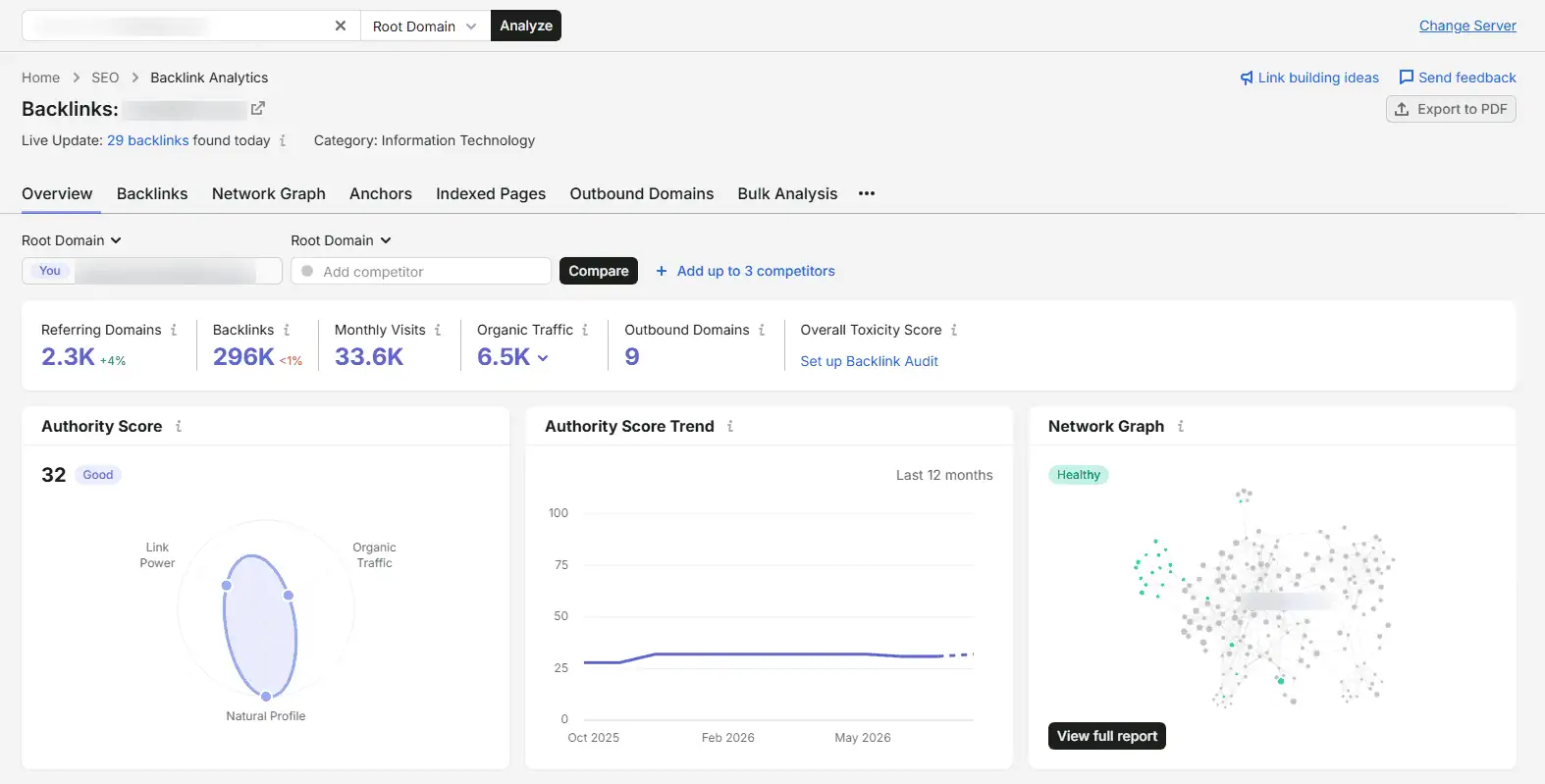
In my own client campaigns, referring-domain growth usually becomes clear within 3 to 5 months. Here's one example of what steady growth looks like in Semrush:
Links on popular, frequently updated sites are found faster. Links on old, rarely crawled pages can take months. New websites usually wait longer than established ones, because Google is still deciding how much to trust them.
10. Why Some Backlinks Never Get Indexed, and What Helps
A backlink only counts if Google crawls and indexes the page it sits on. Many links never get there, usually because the linking page is thin, new, buried deep in a site, or on a domain Google doesn't trust.
You can't request indexing for a page on someone else's website in Search Console. What you can do is choose links that are likely to be found:
- Prefer pages that are already indexed. Search
site:plus the page URL. If it isn't in Google, a link there does little. - Prefer pages linked from the site's homepage or category pages, so crawlers reach them quickly.
- Ask for links on substantial articles, not on pages with two paragraphs and five outbound links.
- Share new guest posts on social channels and in newsletters. Real visits and mentions help pages get discovered.
- Be wary of "backlink indexer" services that blast URLs to spam pages. Many create more junk links than they fix.
If most of the links you're getting never show up in Google, that's not an indexing problem to patch. It's a sign the sites themselves aren't worth the link.
11. A 30-Day Backlink Plan for a New Website
If your site is new, this is a realistic first month. It won't make you rank overnight, but it sets up the foundation and starts a steady flow of good links.
- Week 1, foundation: Google Business Profile, Search Console, 10 to 15 relevant directories and social profiles, and one page on your site that deserves links.
- Week 2, research: list 50 prospects from competitor backlinks, resource pages and "write for us" searches. Note traffic and topic fit for each.
- Week 3, outreach: send 20 personal pitches, sign up for journalist request platforms, and answer 3 to 5 requests in your area.
- Week 4, follow up and track: follow up once, write any guest posts accepted, and log every live link in a simple sheet.
Then repeat weeks 2 to 4 every month. Consistency matters more than any single month's results.
12. Frequently Asked Questions
Short answers to the questions people ask most about getting backlinks.
How can I get backlinks for free?
Turn unlinked brand mentions into links, replace broken links on relevant sites with your own pages, get listed on resource pages, answer journalist requests on platforms like HARO, Qwoted and Featured, and publish something worth citing, such as original data or a free tool. These cost time rather than money.
Are backlinks still relevant in 2026?
Yes. Google still uses links to discover pages and to judge which ones others trust. What changed is quality: a few relevant links from real sites now do more than hundreds of random ones. Being cited on trusted pages also helps AI answers recognise your brand.
How much do backlinks cost?
In 2026, a quality backlink through outreach or a guest post typically costs $80 to $500, depending on the site's traffic, niche and editorial standards. Major publications can cost $500 to $2,000 or more. Monthly link building services range from about $300 to $5,000+ per month.
Is it worth paying for backlinks?
Paying for outreach, writing and research is worth it if you have more budget than time. Paying a site directly for a link that passes ranking credit goes against Google's spam policies and can cost you rankings. Paid placements should be marked rel="sponsored" or nofollow.
How many backlinks are good for a website?
There is no fixed number. Check how many referring domains the top five pages for your keyword have, take the middle figure, and aim for that over several months. Low-competition keywords can need very few; competitive ones may need dozens of relevant domains.
What is the best way to get backlinks?
For most sites, the best way is to find the sites already linking to your competitors and earn a similar link with a better reason to include you, through a guest post, a resource suggestion or a replacement for a broken link. It works because those sites have already shown they link to your topic.
How do I find the backlinks to my website?
Open Google Search Console and go to the Links report. It lists your top linking sites, top linked pages and anchor text, for free. Tools like Ahrefs and Semrush show more detail and also let you look at competitors' backlinks.
Do nofollow backlinks help SEO?
They can help indirectly. Google treats nofollow as a hint rather than a strict rule, and nofollow links can still send visitors, build brand recognition and lead to other followed links. A natural backlink profile always includes a mix of both.
How long does it take for backlinks to work?
Usually four to twelve weeks before you see ranking movement, and three to six months for the full effect. Google has to recrawl the linking page first and then reassess your page. New websites typically wait longer than established ones.
Can buying cheap backlinks hurt my site?
Yes. Bulk packages of hundreds of links for a few dollars are usually automated links on spam pages. At best Google ignores them; at worst they lead to a manual action or lost rankings, and cleaning them up takes far longer than building them did.

Want These Backlinks Built for You?
Researching sites, pitching editors and writing guest posts takes hours every week. If you'd rather spend that time on your business, I do this work for clients every month, with a live report of every link.