Link Building for Startups: The Short Answer
Link building for startups means getting other websites to link to a new company’s site, so Google can find it, trust it and rank it. Start with the free links you already qualify for, point them at your homepage and one or two key pages, then add a few relevant outreach links every month. Give it at least three months before you judge it.
In business terms, link building is how a company earns links and mentions from other websites. Those links bring referral visitors and help its pages rank in Google. The difference for a startup is that you start from zero.
Most startup guides list a dozen tactics and stop there. This one is about order and money: what to do first when nobody knows your brand, what each budget really buys, and when it makes sense to pay someone. I’m Subham Chowdhury. I’ve built links for clients since 2018, and this site, seobysubham.com, is new in 2026, so the outreach numbers below come from the same starting point you’re in.
- Free links first. Company profiles, launch and software listings, partners, investors and customers.
- Send early links to pages that matter. Your homepage, your main product or service page and one resource people want to cite.
- Lead with your brand name in anchor text. Keep exact match keywords rare.
- Match your budget to the competition. Many low-competition keywords need fewer than ten linking sites.
- Track every link. In my own check, 8 of 56 links disappeared within two months.
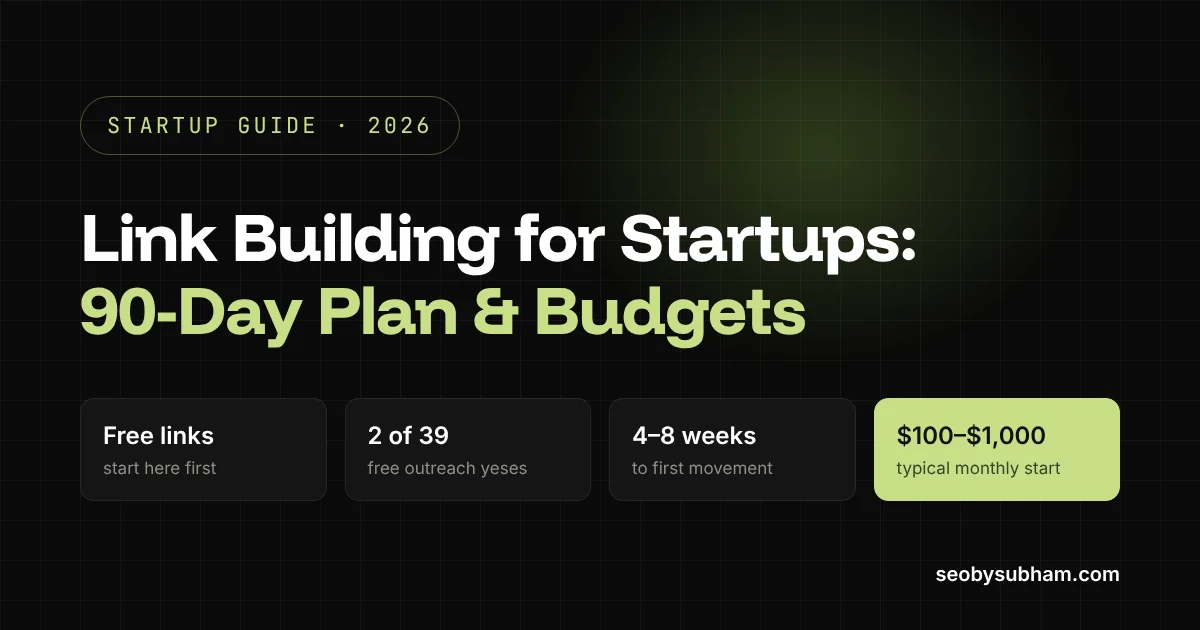
Why Link Building Is Harder for a New Startup
Google still uses links to find pages and decide which ones to trust. Its ranking systems guide says PageRank “continues to be part of our core ranking systems.” A new startup site has almost no links, so Google has little reason to rank it, even when the product is good.
The first links are the hardest, because nobody owes a new brand a link. Here’s what happened when I pitched 39 sites for a free link to this site between October 20 and November 4, 2026:
| Outcome | Sites | Share |
|---|---|---|
| Replied | 22 | 56% |
| Only offered paid placement | 19 | 49% |
| Said yes for free | 2 | 5% |
| No reply | 17 | 44% |
Most replies were price lists. That isn’t a reason to skip outreach. It’s a reason to start with links that don’t depend on a stranger saying yes, and to save cold outreach for when you have something worth linking to. The full data set is in my link building statistics.
The effort pays off. In its 2023 study of about 14 billion pages, Ahrefs found that 96.55% of pages get no traffic from Google at all, and links are one of the things that separate the pages that do.
Before You Build Links: Get 3 Things Ready
- A page worth linking to. Your homepage should say clearly what you do and who it’s for. Then add at least one page other sites can cite: a short data study, a free tool, a pricing page with real numbers or a clear guide. A site with only a homepage and a signup form is very hard to pitch.
- Pages Google can find. Set up Google Search Console, submit your sitemap and check that your key pages are indexed. A link to a page Google hasn’t indexed does nothing yet.
- One consistent brand. Use the same company name, logo, short description and URL on every profile you create. That makes it easier for Google and AI assistants to connect your profiles to your site. Organization schema with links to those profiles helps too.
Which Pages Should Get Your First Links?
Early links are scarce, so send them where they help the business most. For most startups, that means four kinds of pages:
| Page | Why it needs links | Typical anchor text |
|---|---|---|
| Homepage | Profiles, listings, partners and press mentions point here naturally | Your brand name or URL |
| Main product or service page | It makes the money and has to rank for buying searches | Brand plus a topic, such as “Acme invoicing software” |
| One linkable resource | A data study, free tool or guide is far easier to pitch than a product page | The title of the resource |
| Comparison or alternatives pages | Buyers read these right before they choose | Natural phrases, later in the plan |
Lead with your brand name. On October 21, 2026, I checked the anchor text of pages ranking in Google’s US top 10. On service pages, exact match keyword anchors made up only 4% to 16% of linking sites. For a new site, keeping exact match to about 5 to 10% is a sensible start. My anchor text guide has the page-by-page numbers.
Free Backlinks Every Startup Can Get First
These links cost time, not money, and most don’t need a stranger to agree. Do them in your first month.
| Source | Examples | What you get |
|---|---|---|
| Company profiles | LinkedIn company page, Crunchbase, X, YouTube, GitHub for developer tools | Brand mentions and one consistent identity across the web |
| Launch and software directories | Product Hunt, BetaList, G2, Capterra, SaaSHub, AlternativeTo | Discovery, reviews and visitors who are already comparing tools |
| People you already work with | Investors, accelerators, integration partners, suppliers | Relevant links from sites that already know you |
| Your customers | Case studies, “tools we use” pages, testimonials on their sites | Links from real businesses in your market |
| Your founder’s expertise | Journalist request sites like Qwoted and Featured, podcasts, guest articles | Editorial links and mentions in your niche |
| Unlinked mentions | Articles that name your brand without a link | A link where you’re already mentioned. Just ask. |
Many profile and directory links are nofollow. That’s fine. They get your brand found, crawled and mentioned, and they give your link profile a normal base. They support your important links rather than replace them. I explain where this layer fits in my guide to foundation links, and every free method in more detail in how to get backlinks.
A 90-Day Link Building Plan for a New Startup Site
This plan assumes a new domain with almost no links, and a founder or small team doing most of the work. It follows the order that worked in my own campaigns, not a fixed number of links.
| Month | Focus | What to do |
|---|---|---|
| Month 1 | Foundation | Create matching company profiles. List the startup on the launch and software sites that fit. Ask investors, partners and early customers for a link. Publish one linkable resource. Start a sheet that records every link. |
| Month 2 | First outreach | Find 30 to 50 relevant sites in your niche that link to similar companies or resources. Pitch your resource, not your product, in short personal emails. Answer journalist requests every week. Follow up once. |
| Month 3 | Repeat what worked | Do more of the pitches that got replies. Check that every link from month 1 is still live. If you can’t win the few strong links your main page needs, this is where paying for outreach help starts to make sense. |
What to expect: on a brand-new domain I worked on from August 17, 2026, the first rankings showed up after four to six weeks. By mid-October it ranked for 33 keywords, 6 of them on page one, and by November 2 for 88 keywords (Semrush data). That site got profiles, foundation links, Web 2.0 blogs and only two or three outreach links. A small, steady start can go a long way on low-competition keywords. The week-by-week write-up is in my guide on how long backlinks take to work.
How Much Should a Startup Spend on Link Building?
Most small businesses start with $100 to $1,000 a month, and an early-stage startup on low-competition keywords can start at the low end. Under $100 buys a base of foundation links. $100 to $500 buys one to four outreach links on smaller niche sites. Published agency retainers usually run $2,500 to $10,000 a month. Match the budget to your competition, not to a round number.
| Monthly budget | What it usually buys | Good for |
|---|---|---|
| Under $100 | Foundation links, or one placement on a DR 10–20 site | A base for a new site, not a competitive keyword |
| $100 to $500 | 1 to 4 outreach placements on DR 20–40 sites, or 1 to 2 guest posts on sites with 5,000+ monthly visits | Startups and small businesses on long-tail keywords |
| $500 to $1,000 | About 2 to 6 placements on DR 30–50 sites | A market with a few strong competitors |
| $1,000 and up | A productized service or an agency plan | Moderate to strong competition |
For comparison, SEO professionals said they would pay $508.95 on average for one high-quality link in Editorial.Link’s 2026 survey of 518 SEOs, and BuzzStream’s 2026 pricing analysis found published agency retainers running from $2,500 to $10,000 a month. Price lists vary widely, so compare what each link includes, not just the number.
What a small budget did for one client: a small tech site started on my Growth plan. Its organic traffic had been flat at about 200 visits a month from May to August 2026. By September, Semrush estimated about 650, and the client moved to a larger custom plan. That’s an estimate, not Search Console data, and links weren’t the only change. Still, it shows the realistic scale of a small budget: steady growth over months, not page one in weeks. More examples are on my case studies page.
Before you pick a number, check how many sites link to the pages ranking above you. My five-minute method works for any keyword. The full cost breakdown is in my link building pricing guide.
Do It Yourself, Hire a Freelancer or Hire an Agency?
| Option | Typical cost | Watch out for | Best for |
|---|---|---|---|
| Do it yourself | About 5 hours per live link if a pitch takes an hour and 1 in 5 says yes, plus a tool such as Ahrefs Lite at $129 a month | Founder time is your scarcest resource | Free links and the first 1 to 3 months |
| Freelancer or solo specialist | Often about $100 to $400 per placement | Limited capacity. Ask for a sample report and written refund terms. | Small budgets that want to talk to the person doing the work |
| Agency | Published retainers usually run $2,500 to $10,000 a month | Contracts. Some agencies ask for six-month terms. | Funded startups that need volume and strategy |
My honest advice for most startups: do the free links yourself. Nobody tells your founder story better than you, and partners and investors answer you faster than a hired link builder. Bring in help when you need links you can’t win on your own, usually for your main product or service page. That’s the work my link building services cover, from $50 a month. I’m a solo specialist myself, so weigh my view with that in mind.
My guide to outsourcing link building covers how to hand it off without losing control, and how to choose a link building service lists 12 checks to run before you pay anyone.
Link Building for SaaS Startups: What’s Different
Software startups have a few link sources most businesses don’t:
- Integration and partner pages. If your product connects with another tool, ask to be listed on its integrations or marketplace page.
- Software review sites. G2, Capterra and similar sites bring visitors who are already comparing options.
- Your own comparison and alternatives pages. They earn fewer links, but buying decisions happen there, so link to them from your blog posts.
- Data only your product has. Anonymous, combined usage data can become a story other sites want to cite.
- Founder-written guest articles about problems your customers have, on sites your buyers read.
The order doesn’t change: profiles and partners first, then outreach for the pages that sell.
Link Building for Small Businesses
A small business usually needs fewer links than a startup going after national keywords. Local and niche searches have less competition, so a handful of relevant links can move rankings. The best early links come from real relationships: your local chamber of commerce, suppliers and brands you stock, local news, local event sponsorships and industry associations. For map results, a complete Google Business Profile matters too.
On budget, most small businesses start at $100 to $1,000 a month. A local business in a narrow area often needs less. A small online store up against national brands may need the top of that range.
7 Link Building Mistakes That Waste a Startup’s Money
- Buying cheap links in bulk. Packages of hundreds of links for a few dollars come from sites built to sell links. Google’s spam policies treat buying or selling links that pass ranking credit as link spam.
- Judging a site by DA or DR alone. In November 2026 I checked 18 publishers that had asked me for money. None had 5,000+ monthly organic visits with mostly US and UK readers. One that led with its DR 65 got about 70% of its estimated traffic from outside the US and UK.
- Paying for sites with no readers. Four of those 18 sites had no measurable organic traffic, yet still quoted between $9.50 and $250 per post.
- Using your main keyword as anchor text everywhere. Service pages ranking today get most of their links with brand names and natural phrases.
- Sending every link to blog posts. A link to an article mostly helps that article. If your product page needs to rank, give it links too, directly or through internal links from the posts that earn them.
- Quitting after a month. Links take time to be found and counted. In my recent campaigns, the first movement came 4 to 8 weeks after link building started.
- Not tracking links. Of 56 links I built in September 2026, 8 had disappeared by November. Keep a sheet with every link, the page it points to and the date, and check it monthly.
Frequently Asked Questions
How many backlinks does a startup need?
There’s no fixed number. Look at the top five pages for your main keyword, check how many sites link to each one, and aim for the middle figure over several months. For many low-competition keywords, that’s fewer than ten linking sites. My guide on how many backlinks you need shows the method with live examples.
How long does link building take for a new website?
In my recent campaigns, the first ranking or traffic movement came 4 to 8 weeks after link building started. Most of my monthly clients see clear ranking and traffic gains after 3 to 5 months. Competitive keywords take longer.
Can a startup get backlinks for free?
Yes. Company profiles, launch and software directories, partner and investor pages, customer case studies, journalist requests and unlinked brand mentions all cost time rather than money. They are the right place to start before any paid outreach.
Is it safe for a startup to buy backlinks?
Paying a site directly for a link that passes ranking credit goes against Google’s spam policies, and paid placements should be marked rel="sponsored" or nofollow. Bulk link packages are the riskiest option. Paying someone for research, outreach and writing is different: you pay for the work, and the site owner decides whether to link.
Should a startup hire an agency or do link building in-house?
Do the free links yourself first, because partners, investors and customers respond best to the founder. Hire help when you need links you can’t win on your own. A freelancer often charges about $100 to $400 per placement, while published agency retainers usually run $2,500 to $10,000 a month.
What is the best link building strategy for a SaaS startup?
Start with software directories, review sites and integration partner pages, then publish data only your product has and pitch it to sites your buyers read. Point early links at your homepage and main product page, and use your brand name in most anchors.
How much does link building cost for a small business?
Most small businesses start with $100 to $1,000 a month. That usually buys a few outreach links or one or two guest posts on relevant sites. A local business in a narrow area often needs less. My link building pricing guide breaks costs down by link type.

Send Me Your Site
Send me your site and the page you want to rank. I’ll tell you which links it needs first and what they cost, before you pay anything.